GEO vs AEO: What is the difference and when to use each?
同根異派
"Same root, different branches" / Common origin with different approaches
The marketing acronym explosion continues: SEO, AEO, GEO, and inevitably someone will coin a few more. For marketers trying to stay ahead, this alphabet soup creates legitimate confusion.
Are GEO and AEO the same thing?
Different names for the same strategy?
Competing approaches?
Or complementary tactics serving different goals?
This article cuts through the confusion with clear definitions, practical distinctions, and strategic guidance on when to use each approach—or both.
Spoiler: They overlap significantly but serve different purposes. Understanding the distinction helps you allocate resources effectively and avoid redundant efforts.
The Core Definitions (What the Acronyms Actually Mean)
Let’s start with precise definitions:
What is AEO (Answer Engine Optimization)?
Answer Engine Optimization is the practice of optimizing content to appear in direct answer formats across search platforms—specifically:
Featured Snippets on Google (position zero)
People Also Ask (PAA) boxes
Google AI Overviews (the synthesized answer above traditional results)
Answer boxes on ChatGPT Search, Perplexity, and other AI search engines
Knowledge Graph panels
The goal: Be the source selected to answer a specific query directly, before traditional results.
The format: Usually a short, extracted snippet (40-300 words) pulled from your content and displayed prominently.
User behavior: User may get answer without clicking (zero-click), or click for more detail.
Primary platform: Still heavily focused on Google, though expanding to AI search engines.
What is GEO (Generative Engine Optimization)?
Generative Engine Optimization is the practice of maximizing brand visibility and favorable positioning in AI-generated responses across conversational AI platforms—specifically:
ChatGPT (standard chat and ChatGPT Search)
Perplexity AI
Claude
Gemini (Google)
Google AI Overviews
SearchGPT (OpenAI)
Other emerging AI answer engines
The goal: Be cited, mentioned, or recommended when AI synthesizes responses to questions about your category.
The format: AI-generated narrative response synthesizing multiple sources, with citations to original content.
User behavior: User reads synthesized answer; may or may not click citations. Often continues conversation with follow-up questions.
Primary platforms: Conversational AI platforms and AI-powered search engines.
The Overlap: Where AEO and GEO Are the Same
Let’s address the obvious: There’s significant overlap. Many tactics work for both.
Shared Optimization Tactics:
Both AEO and GEO benefit from:
✅ Clear, structured content
H1/H2/H3 hierarchy that’s logical
Short paragraphs focused on one idea
Bullet points and lists for scannable content
Clear topic sentences
✅ FAQ format and question-based content
Direct question as heading (H2 or H3)
Concise answer immediately following
Additional detail and context below
Multiple related questions addressed
✅ Schema markup
Article schema
FAQ schema
HowTo schema
Organization schema
✅ Specific, factual answers
Direct responses to questions
Concrete data and statistics
Avoid vague claims or fluff
Back up statements with evidence
✅ Authority and credibility signals
Author expertise and credentials
Cited sources and references
Trust indicators (awards, certifications, testimonials)
Up-to-date information with publication dates
✅ Mobile-friendly, fast-loading pages
Technical performance matters for both
User experience signals
Crawlability and indexability
For comprehensive AEO tactics, read: The Complete Guide to Answer Engine Optimization (AEO)
For foundational context on GEO and why it matters, read: What is GEO (Generative Engine Optimization)?
The Difference: Where AEO and GEO Diverge
Despite the overlap, they serve different purposes and require different strategic priorities.
1. Primary Platform Focus
AEO:
Primarily Google-focused (featured snippets, PAA, AI Overviews)
Also applies to Bing and other traditional search engines
Expanding to AI search but roots are in traditional SERP features
GEO:
Primarily AI platform-focused (ChatGPT, Perplexity, Claude, Gemini)
Google AI Overviews are included but not the sole focus
Conversational AI is the primary use case
Practical implication: AEO strategies prioritize Google’s SERP features. GEO strategies prioritize standalone AI platforms where users never see traditional search results.
2. Content Source and Citation Approach
AEO:
Primarily pulls from your own website (70-90% of featured snippets)
Google selects one source to feature
Your on-page content is the primary signal
Backlinks and domain authority strongly influence selection
GEO:
Synthesizes from multiple sources (typically 3-10 sources per response)
Your website is only 5-10% of citations
Third-party mentions are critical - What others say about you matters more
Publishers, reviews, communities, and user-generated content dominate
Example:
AEO query: “What is marketing automation?”
Google pulls a 60-word definition from a single authoritative site
Featured snippet appears at position zero
One winner takes the featured position
GEO query: “What’s the best marketing automation platform for mid-market B2B companies?”
ChatGPT synthesizes response from 6-8 sources
Mentions 3-4 specific platforms
Cites industry reviews, comparison articles, user testimonials
Your own product page might not be cited even if you’re recommended
3. Format and Presentation
AEO:
Extracted snippet - Direct excerpt from your content
Usually 40-300 words
Preserves your wording (with minor edits)
Link to your page is prominent
User sees your domain name
GEO:
Synthesized narrative - AI rewrites in its own words
Variable length (can be 200-2000+ words)
Combines information from multiple sources
Citations may be listed at end (or inline)
User may not notice specific sources
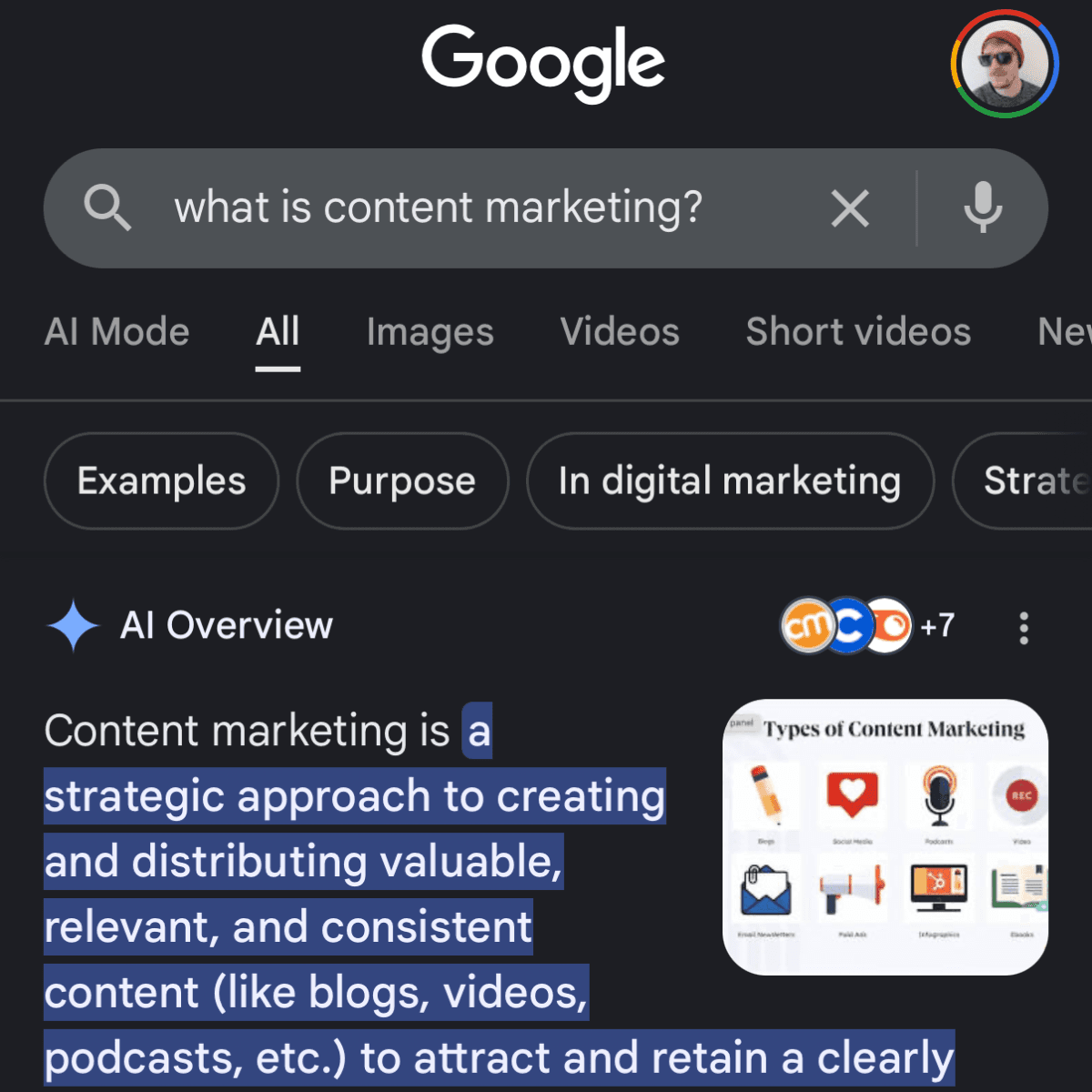
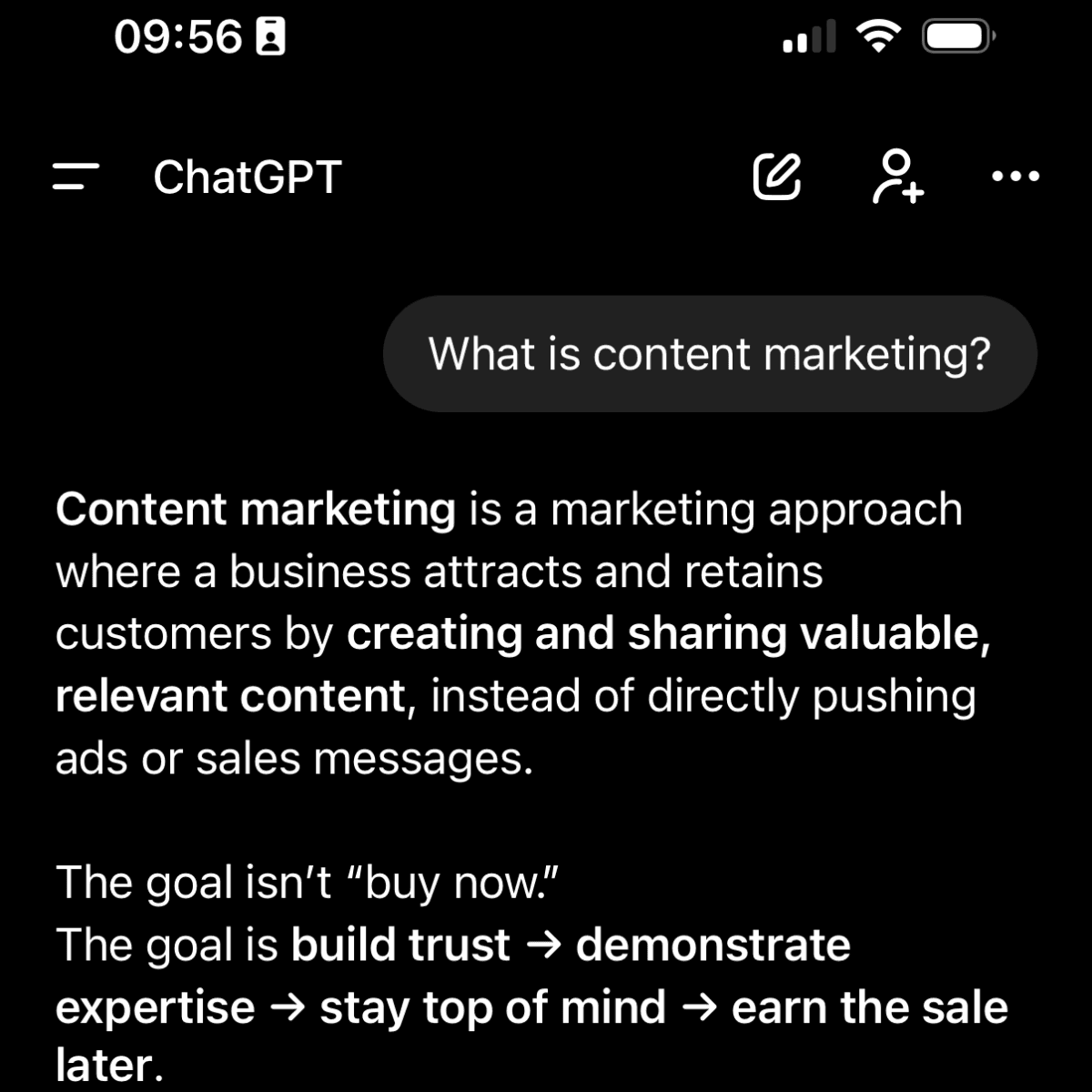
Visual comparison:
AEO (Featured Snippet):
GEO (ChatGPT Response):
4. User Intent and Behavior
AEO:
Informational queries - “What is X?”, “How to Y?”, “When does Z?”
User wants quick answer
May click through for more detail or leave satisfied
Zero-click behavior common (60-77% of searches)
GEO:
Broader range of intent - Informational, navigational, commercial, transactional
User often asks follow-up questions
Conversational interaction continues
Citation clicks less common (users trust AI synthesis)
5. Competitive Dynamics
AEO:
Winner-takes-all - Only one featured snippet per query
If a competitor owns the snippet, you’re invisible
Displacement strategy required
GEO:
Multiple mentions possible - AI can cite 3-5+ brands
Being mentioned alongside competitors is common
Context matters (top choice vs alternative vs mentioned)
Example:
AEO: Query “best CRM for small business”
Featured snippet shows one article comparing CRMs
Only that one site gets featured snippet position
Other sites ranked #1-10 get less visibility
GEO: Query “best CRM for small business”
ChatGPT mentions HubSpot, Salesforce, and Zoho
Cites 3 comparison articles, 2 review sites, Reddit discussion
Multiple brands get visibility in one response
6. Optimization Timeline
AEO:
Faster results possible - Can earn featured snippet within weeks
Requires strong existing rankings (typically top 5-10)
Tactical on-page optimization can win snippets quickly
GEO:
Longer strategic play - Building citation-worthy authority takes time
Less dependent on existing rankings
Third-party validation is the bottleneck (publications, reviews, community presence)
The Venn Diagram: Visualizing AEO vs GEO
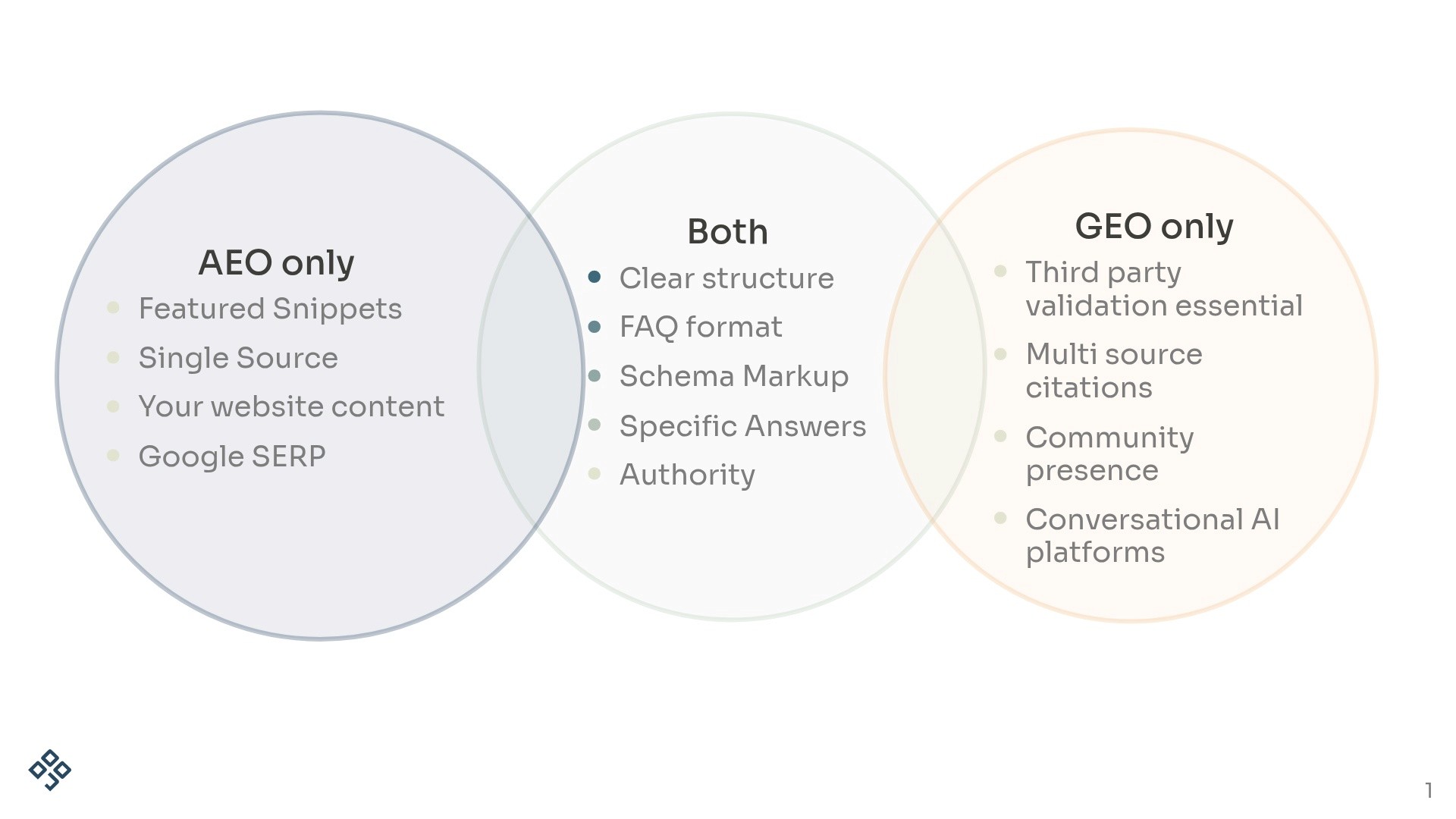
Left circle (AEO only): Tactics specific to traditional search engine answer formats Center overlap: Tactics that benefit both AEO and GEO Right circle (GEO only): Tactics specific to AI-generated conversational responses
AEO only | Both | GEO only |
|---|---|---|
Featured Snippet focus | Clear structure | “Third Party validation essential” |
Single Source | FAQ Format | “Multi Source Citations” |
Your website content | Schema Markup | Community Presence |
Google SERP | Specific Answers & Authority | Conversational AI Platforms |
When to Focus on AEO vs GEO
The strategic question: Where should you invest your limited time and resources?
Prioritize AEO If:
✅ You already rank well in traditional search (top 10)
AEO builds on existing SEO success
Featured snippets typically come from top 5-10 results
If you’re ranking #5-10, winning snippets moves you to position zero
✅ Your queries have clear, definable answers
“What is X?” definitions
“How to do Y?” step-by-step processes
“When does Z happen?” factual information
Simple, structured questions
✅ Your audience still primarily uses Google search
Older demographics (45+)
Less tech-forward industries
Local or region-specific businesses
✅ You need quick wins
Can optimize existing content for snippets in weeks
Don’t have to wait for third-party validation
Immediate traffic and visibility impact
✅ You have strong domain authority but weak AI presence
Your website is authoritative in Google’s eyes
But you’re not being cited by AI platforms
AEO is lower-hanging fruit
Prioritize GEO If:
✅ Your audience is younger and tech-forward (18-34)
2.5x more likely to use AI search
Tech industry, SaaS, digital products
Early adopters and innovators
✅ Your queries are complex, comparative, or opinion-based
“What’s the best X for Y situation?”
“X vs Y comparison”
“Should I choose X or Y for Z use case?”
Nuanced, context-dependent questions
✅ You compete in zero-click categories
Featured snippets answer the question completely
Users don’t click through
Being mentioned in AI response is the only visibility
✅ You’re a challenger brand with limited SEO rankings
Don’t rank in top 10-20 yet
GEO doesn’t require existing search rankings
Can build AI citations while working on SEO
✅ You have strong brand awareness but weak content
People know your brand
Your website content isn’t comprehensive
AI may already cite you based on third-party mentions
Do Both If:
✅ You’re a mid-market or enterprise company with resources
Can invest in both strategies simultaneously
Team capacity for multifaceted approach
Budget for tools and measurement
✅ You operate in a competitive, high-value category
Can’t afford to ignore any visibility channel
Competitors are active in both
Market leadership requires comprehensive presence
✅ Your audience spans multiple demographics
Younger users on AI platforms
Older users on Google
Need coverage across all channels
The Integrated Approach: AEO + GEO Strategy
The smartest approach for most brands: Start with AEO, layer in GEO.
Phase 1: AEO Foundation (Months 1-3)
Build capabilities that benefit both:
Identify target queries
Questions your audience asks
Queries with existing featured snippets (analyze competitors)
Questions you can answer authoritatively
Create/optimize FAQ content
Direct question as H2
Concise 40-60 word answer immediately following
Detailed explanation below
Implement FAQ schema
Structure existing content for snippets
Add clear definitions
Create comparison tables
Build step-by-step HowTo sections
Use lists and bullets
Win your first featured snippets
Start with queries where you rank #3-7
Optimize specifically for snippet format
Track and measure success
Goal: Win 5-10 featured snippets. Establish answer-format content foundation.
Phase 2: Layer in GEO Tactics (Months 3-6)
Expand beyond your own website:
Audit AI visibility
Check ChatGPT, Perplexity, Claude, Gemini
Document where you’re cited (or not)
Identify citation sources (what do they reference?)
Build third-party presence
Get featured in industry publications
Participate authentically in relevant communities (Reddit, forums)
Earn reviews on G2, Capterra, TrustRadius
Publish original research that others cite
Create citation-worthy content
Go beyond snippets to comprehensive guides
Include original data and statistics
Add specific examples and case studies
Make content structured and AI-parseable
Update content for AI comprehension
Add more specific data
Include multiple perspectives
Structure for both human and AI readers
Keep information current
Goal: Get cited in 20-30% of relevant AI queries. Build authority beyond your website.
Phase 3: Optimize Both Channels (Months 6-12)
Refine based on what’s working:
Expand snippet coverage - Target more competitive queries
Increase AI citation rate - Aim for 50%+ of relevant queries
Monitor competitors - Track their AEO and GEO performance
Update systematically - Refresh content quarterly
Measure ROI - Track traffic, citations, and business impact
AEO vs GEO: Side-by-Side Comparison
Dimension | AEO (Answer Engine Optimization) | GEO (Generative Engine Optimization) |
|---|---|---|
Primary Goal | Win featured snippets and answer boxes | Get cited in AI-generated responses |
Primary Platforms | Google, Bing (traditional search) | ChatGPT, Perplexity, Claude, Gemini |
Content Source | Your website (70-90% of snippets) | Multiple sources (your site is 5-10%) |
Citation Format | Extracted snippet from your content | Synthesized narrative from multiple sources |
Third-Party Validation | Helpful but not required | Essential for citations |
Competitive Dynamics | Winner-takes-all (one snippet) | Multiple brands can be cited |
User Intent | Primarily informational queries | All intent types (informational, commercial, transactional) |
Time to Results | Faster (weeks if ranking well) | Slower (months for authority building) |
Required Ranking | Typically need top 10 ranking | Rankings less relevant |
Optimization Focus | On-page content structure | Third-party authority building |
Measurement | Snippet ownership, traffic from position zero | Citation frequency, share of voice, sentiment |
Content Type | Short, direct answers (40-300 words) | Comprehensive, citation-worthy content |
Schema Importance | Important for selection | Critical for AI parsing |
Update Frequency | Moderate - maintain accuracy | High - AI prioritizes freshness |
Domain Authority Impact | High - strong signal for snippet selection | Moderate - expertise matters more than age |
Practical Examples: AEO vs GEO in Action
Example 1: Informational Query
Query: “What is email marketing automation?”
AEO Approach:
Create page with clear H1: “What is Email Marketing Automation?”
Write 60-word definition immediately under H1
Add detailed explanation below
Implement FAQ schema
Optimize for snippet extraction
Expected AEO Outcome:
Google features your 60-word definition
You own position zero
Users click through or get answer without clicking
GEO Approach:
Publish comprehensive guide on email automation
Include original statistics on adoption and ROI
Get featured in MarTech publications discussing email automation
Participate in r/emailmarketing helping people
Earn reviews highlighting your email automation features
Expected GEO Outcome:
ChatGPT includes your definition alongside others
Cites your original research data
References your brand when discussing solutions
Mentions you in context of email automation platforms
Key difference: AEO wins the snippet. GEO builds broader authority and gets cited across many related queries.
Example 2: Commercial Query
Query: “Best project management software for remote teams”
AEO Approach:
Create comparison article
Structure with clear headings (Top 5, Top 10)
Use comparison table
Optimize for featured snippet format
Expected AEO Outcome:
Your comparison article wins featured snippet
Users click to see full list
Direct traffic to your site
GEO Approach:
Same comparison content, but add original research
Get quoted in Fast Company article about remote work tools
Build presence in r/projectmanagement helping teams
Earn 100+ G2 reviews from remote teams
Publish “State of Remote Team Productivity” study
Expected GEO Outcome:
ChatGPT recommends specific tools (potentially including yours if you’re a vendor)
Cites multiple sources including your research
References community discussions
User may never visit your site but forms opinion based on AI description
Key difference: AEO drives clicks. GEO builds brand perception and awareness even without clicks.
For platform-specific optimization tactics across ChatGPT, Perplexity, and more, read: How to Optimize for ChatGPT, Perplexity & AI Search Engines
Common Misconceptions About AEO and GEO
Misconception 1: “They’re the same thing with different names”
Reality: Significant overlap in tactics, but different strategic priorities. AEO focuses on your own website content and SERP features. GEO requires building authority beyond your site.
Misconception 2: “GEO will replace AEO”
Reality: Both will coexist. Traditional search isn’t disappearing. Google still commands 86% of search traffic. AEO remains relevant for featured snippets.
Misconception 3: “AEO is just old SEO rebranded”
Reality: AEO has specific tactical focus on answer formats (snippets, PAA boxes, AI Overviews) that standard SEO doesn’t emphasize. It’s a subset of SEO with distinct optimization requirements.
Misconception 4: “GEO doesn’t matter because AI search is small”
Reality: 41% of consumers intentionally use AI search (McKinsey, Oct 2025). ChatGPT has 800M weekly users. Perplexity grew 192% in 12 months. It’s not small anymore.
Misconception 5: “You need different content for AEO vs GEO”
Reality: Much of the same content can serve both. The difference is in distribution and authority building, not content creation from scratch.
Measuring Success: AEO vs GEO Metrics
AEO Success Metrics:
Featured snippet ownership
Number of snippets owned
High-value keywords with snippets
Snippet retention rate
Position zero traffic
Traffic from featured snippets
Click-through rate from snippets
Conversions from snippet traffic
PAA box appearances
Number of PAA boxes where you appear
Related question coverage
AI Overview citations (Google)
Percentage of AI Overviews citing you
Context and positioning in AI Overviews
GEO Success Metrics:
Citation frequency
% of relevant queries where you’re mentioned
Absolute number of citations per platform
Share of voice
Your citations vs competitor citations
Category dominance percentage
Citation context
Top recommendation vs alternative vs mentioned
Sentiment (positive, neutral, negative)
Source diversity
Number of different sources AI cites about you
Mix of publishers, communities, reviews, your site
Platform coverage
Citations across ChatGPT, Perplexity, Claude, Gemini
Platform-specific visibility
Combined Dashboard Example:
Metric | Current | 3-Month Goal | 6-Month Goal |
|---|---|---|---|
AEO | |||
Featured Snippets Owned | 8 | 20 | 35 |
Snippet Traffic/Month | 2,500 | 6,000 | 10,000 |
AI Overview Citations (Google) | 12% | 30% | 50% |
GEO | |||
AI Citation Rate (All Platforms) | 15% | 35% | 55% |
Share of Voice vs Top Competitor | 20% | 40% | 60% |
Sources Citing You | 8 | 20 | 40 |
Positive Sentiment Rate | 70% | 85% | 90% |
For comprehensive tool recommendations to track both AEO and GEO, read: GEO Tools: The Complete Guide (coming soon)
The Bottom Line: Does the Terminology Actually Matter?
Here’s the pragmatic answer: Not really.
Call it AEO, call it GEO, call it “AI search optimization” or “answer optimization” or whatever resonates with your team.
What matters is the strategy:
Optimize for answer formats (snippets, AI responses)
Structure content for machine comprehension (schema, clear hierarchy)
Build authority beyond your website (publications, reviews, communities)
Create citation-worthy content (original data, specific examples)
Track visibility across all platforms (Google, ChatGPT, Perplexity, etc.)
Whether you organize this as “AEO + GEO” or “comprehensive AI search strategy” is semantic.
The critical strategic questions are:
Where is our audience searching? (Google? ChatGPT? Both?)
Where are we currently visible? (Traditional search? AI responses? Neither?)
Where are our biggest gaps? (Featured snippets? AI citations? Both?)
What will drive the most business impact? (Snippet traffic? Brand awareness? Both?)
Answer those questions, and the tactics become clear regardless of acronyms.
For strategic guidance tailored to challenger brands with limited resources, read: GEO Strategy for Challenger Brands (coming soon)
For the complete foundational comparison with traditional SEO, read: GEO vs SEO: What’s the Difference and Why It Matters in 2026
Next Steps: Build Your Integrated AEO + GEO Strategy
Continue Your GEO Journey:
What is GEO (Generative Engine Optimization)? - Complete introduction to GEO and why it matters
GEO vs SEO: What’s the Difference? - Understand how GEO differs from traditional SEO
How to Optimize for ChatGPT, Perplexity & AI Search Engines - Platform-specific optimization tactics
GEO Strategy for Challenger Brands (coming soon) - Strategic framework for resource-constrained teams
GEO Tools: The Complete Guide (coming soon) - Software and platforms for tracking AI visibility
Deepen Your AEO & SEO Knowledge:
The Complete Guide to Answer Engine Optimization (AEO) - Comprehensive AEO tactics and implementation
How to Rank Higher in AI Search: A Practical Guide - Tactical steps for AI search optimization
AI Marketing: The Complete Guide for Challenger Brands - Broader AI marketing strategy context
Get Started with DOJO AI:
Want to track your performance in both featured snippets and AI citations? DOJO AI’s platform provides comprehensive monitoring across traditional and AI search.
Our SEO, AEO & GEO capabilities help you:
Monitor featured snippet ownership and opportunities
Track AI citations across ChatGPT, Perplexity, Gemini, Claude, and Google AI Overviews
Identify content gaps and optimization opportunities
Compare your visibility to competitors in both channels
Measure and improve your integrated search performance
Learn more about DOJO AI’s SEO & AEO capabilities | Try DOJO AI Free for 14 Days
Published January 2026 | Updated with latest 2025-2026 data
About the Author: This guide was created by Luke Costley-White, he’s our Founding Growth Sensei in the DOJO AI team, the article was written based on analysis of featured snippet performance, AI citation patterns, and real results from brands implementing integrated AEO + GEO strategies.