Marketing Knowledge Management: What to Capture, Who Owns It, Where It Lives

Luke Costley-White

Adclear and DOJO AI partnership graphic: 'Close the loop on agentic marketing. Compliance at the speed of creation.'
温故知新
Review the old to know the new

Your CEO forwards you an email. Then a screenshot of a social post that went out the same week. The messaging doesn't match. Nobody lied, nobody missed a brief; two different people just made two reasonable, disconnected decisions, because neither of them could see what the other had already decided.

A new hire starts on Monday. By Thursday, most of their onboarding time has gone into a scavenger hunt: which Slack channel has the brand voice doc, which Google Drive folder has the "real" positioning deck (there are three), who actually knows why the last rebrand happened.

An analyst spends three days re-running a competitive analysis, confident nobody's done it before. Then someone finds the deck: it exists, it's good, it's eight months old, and it was buried in a folder nobody thought to search.

None of these are knowledge management failures in the abstract sense. They're specific, recurring, expensive moments where a marketing team already had the answer and couldn't find it, or never wrote it down at all. This guide is about fixing that: what to capture, how to set it up, who should own it, and where it should actually live.


Why marketing needs its own kind of knowledge management

The instinct, once a team feels this pain, is to reach for a knowledge base tool: Confluence, Notion, maybe the knowledge base feature already sitting inside HubSpot. That instinct isn't wrong, but it solves the wrong layer of the problem, because a marketing knowledge base is answering a different question than a customer support knowledge base.

A support knowledge base exists to answer: what does the customer need to know about our product? It's built around consistent, repeatable answers to a fixed set of questions.

A marketing knowledge base needs to answer something structurally different: what does the team need to know about the world around the brand, right now, to make the next decision well? That's not a fixed set of questions with fixed answers. It's four categories of knowledge, none of which a generic knowledge base tool is built around:

  • Brand history. What's been claimed, positioned, and said before, so the next campaign doesn't contradict it.

  • Competitive intelligence. What rivals are actually doing, and whether it matters.

  • Customer evidence. Real reviews, objections, and language customers actually use, not what the team assumes they'd say.

  • Campaign and creative performance history. What actually worked, and why, not just what ran.

That's urgent, not a nice-to-have, for a simple reason: this kind of judgment lives almost entirely in people's heads, and people leave. Deloitte's 2026 Global Human Capital Trends research describes a "$9 trillion knowledge exodus," tied to the wave of Baby Boomer retirements taking institutional knowledge with them as they go. Marketing teams aren't exempt from that math; if anything, marketing roles turn over faster than most.

The most visible symptom of this is brand inconsistency, and the numbers on it are stark. Research from Marq (formerly Lucidpress) found that 85% of organizations have brand guidelines, but only around 30% enforce them consistently. Worth flagging honestly: that's vendor-sponsored research from a brand-templating company, not an independently audited academic study, so treat the exact figures as directional rather than gospel. But the gap they're describing is real and easy to recognize: the guideline exists in a PDF is one problem. The guideline gets surfaced at the exact moment someone is writing an ad is a completely different problem, and only a live, connected system solves the second one.

This is where the trap closes on the generic-tool instinct. Confluence, Notion, and a company's own HubSpot knowledge base are genuinely good at storing documents. None of them are built to notice that a competitor just repositioned, that a customer review just contradicted a claim on the pricing page, or that last quarter's campaign taught something relevant to the brief being written today, because none of them are watching anything. They're libraries. A library only helps if someone remembers to walk in, and the value of connected knowledge is that it compounds instead of resetting every time someone forgets .


What actually belongs in a marketing knowledge system

Before "how to build it," it's worth being specific about what's actually being built, because most advice on this topic skips straight to tooling and never defines the object.

Brand history means the decisions, not just the deliverables: why the last five campaigns were positioned the way they were, what got tested and rejected, what the brand has already promised and can't contradict. This is the piece that closes the CEO's email-versus-social gap from the opening: if the last five campaigns' messaging decisions lived in one place, that gap never opens, because whoever wrote the social post would have seen what the email already said.

Competitive intelligence means what a rival changed and whether it's actually relevant, not a quarterly slide deck that's stale before it's presented. A pricing page update, a repositioning, a new feature launch: each is a small, timely fact, and the value is in catching it close to when it happens.

Customer evidence means the actual words customers use: objections from sales calls, language from reviews, the phrase a prospect used that the team would never have written themselves. This is consistently the most valuable and most siloed input in a marketing organization, because it lives inside conversations marketing usually never hears.

Campaign and creative performance history means what worked and why, tied to the actual creative and the actual audience, not a generic "email works well for us" takeaway. The "why" is the part that gets lost first: six months later, someone remembers that a campaign did well, but not which specific line, offer, or audience made the difference.

Notice what's true of all four: none of this requires DOJO, or any specific vendor, to exist. A disciplined team could build a version of this today with a shared document and real habits. That's the point. The system comes later. The categories are the actual object being managed.


How to actually set it up

This is a sequence, not a tool purchase.

1. Audit before you build. Find out what already exists, where it lives, and whose head it's actually in. Most teams are surprised by how much they already have scattered across decks, Slack threads, and one person's memory; the problem usually isn't a lack of knowledge, it's that none of it is in one place.

2. Capture at the moment of creation, not after the fact. The single best habit a marketing team can build here is writing down the decision while it's being made, not reconstructing it later from memory. A one-line note in the campaign brief ("we're avoiding this claim because of X") takes ten seconds and saves someone else three days six months from now.

3. Structure around the four knowledge categories, not around channels or teams. Most knowledge bases get organized by document type (decks, briefs, guidelines) or by department (paid, content, brand). Neither structure matches how a decision actually gets made. Organize around brand history, competitive intelligence, customer evidence, and campaign performance instead, because that's the shape of the question someone is actually asking when they go looking.

4. Build in continuous external ingestion, not a one-time upload. A knowledge base populated once and left alone starts decaying immediately: competitor moves (this is what proactive competitive intelligence is actually for), customer reviews, and market signals need to keep flowing in on their own, or the system is stale within a quarter. This is where a lot of "AI-powered" knowledge tools quietly fail: research from Atlan, a data-context platform that studies this specifically, found that roughly 80% of enterprise RAG (retrieval-augmented generation) deployments, the kind of AI search sitting on top of most document stores, fail to perform reliably in production, and the failures trace back to what's being retrieved, not the underlying model. A system that looks intelligent but is just searching a pile of increasingly outdated documents will produce confident, wrong answers, and a knowledge base with nothing reading and acting on it, no proactive AI marketing agents , is just a library with better search.

5. Review and retire on a cadence. Set a recurring check, quarterly at minimum, and a lighter one after every major campaign: fifteen minutes to update what changed, retire what's no longer true, and flag what's missing. Knowledge that never gets reviewed becomes the digital junk drawer every unmaintained knowledge base eventually turns into.

Which systems actually need to be connected

Step four above, continuous external ingestion, is a principle. Here's what it actually means in practice, because most of what a marketing team needs to know isn't written down anywhere. It's sitting inside eight or nine disconnected platforms, updating every day, that nobody is systematically reading.


System / channel

What it contributes to the knowledge system

Why a document can't replace it

Paid ads (Google Ads, Meta Ads, LinkedIn Ads)

Campaign, ad set, and creative-level performance; what's actually converting versus what's just running

Performance shifts daily; a quarterly deck showing "what worked" is stale before the next campaign launches

SEO (Search Console, rankings, backlinks, technical health)

What the brand ranks for, what's slipping, where competitors are gaining ground, technical issues suppressing visibility

Rankings move weekly; a static SEO audit from six months ago actively misleads the next content brief

AEO / AI search visibility

Whether AI answer engines (ChatGPT, Perplexity, Gemini) cite the brand, and where competitors are winning citations instead

This category barely existed 18 months ago; there's no legacy document to be out of date, the knowledge has to be captured live or not at all

Marketing CRM / email (e.g. Klaviyo)

Campaign and flow performance, list health, deliverability, what messaging is actually landing with subscribers

Segment behavior and deliverability reputation change continuously; a "what our audience responds to" doc is an opinion until it's checked against live send data

Sales CRM (e.g. HubSpot, Clarify) including meetings, calls, and email activity

Real buyer language, objections, and the actual reasons deals win or stall, straight from the conversations sales is having

This is the single most valuable and most commonly siloed input; marketing routinely writes messaging with zero visibility into what prospects actually say on sales calls

Organic social

What content resonates, what tone and topics the audience engages with, competitor and community conversation

A content calendar reflects intent; social performance and listening data reflect reality, and the two drift apart within weeks

Commerce / shop data (e.g. Shopify)

Real revenue, order, and customer behavior tied back to campaigns, not just clicks and impressions

Without this, "marketing knowledge" stops at the click and never learns what actually drove revenue

Data warehouse (e.g. BigQuery)

Whatever first-party data the business already centralizes: revenue, product usage, customer records, joined against marketing activity

This is often the most accurate, least biased version of "what actually happened" that already exists; a knowledge system that ignores it works from a worse copy of the truth the company already owns

Connecting these systems isn't the same as having a dashboard for each one. A dashboard answers "what happened in this channel." A connected knowledge system answers a harder question: given everything happening across every channel, what does the team need to know right now to make the next decision well? That requires reading the systems together, not tab by tab.

This is also where most attempts at "connecting everything" quietly fail, in the same way described above: the connection is a one-time export into a spreadsheet or a slide, not a live read. Six months later, that export is just a slightly more organized version of the same stale archive.

The shape of the whole system, once it's actually wired up, looks less like a document library and more like a loop: signals come in from every channel, get captured and curated into a connected knowledge layer, and flow back out into the work that channel actually needs done, with outcomes feeding back in to keep the whole thing current.
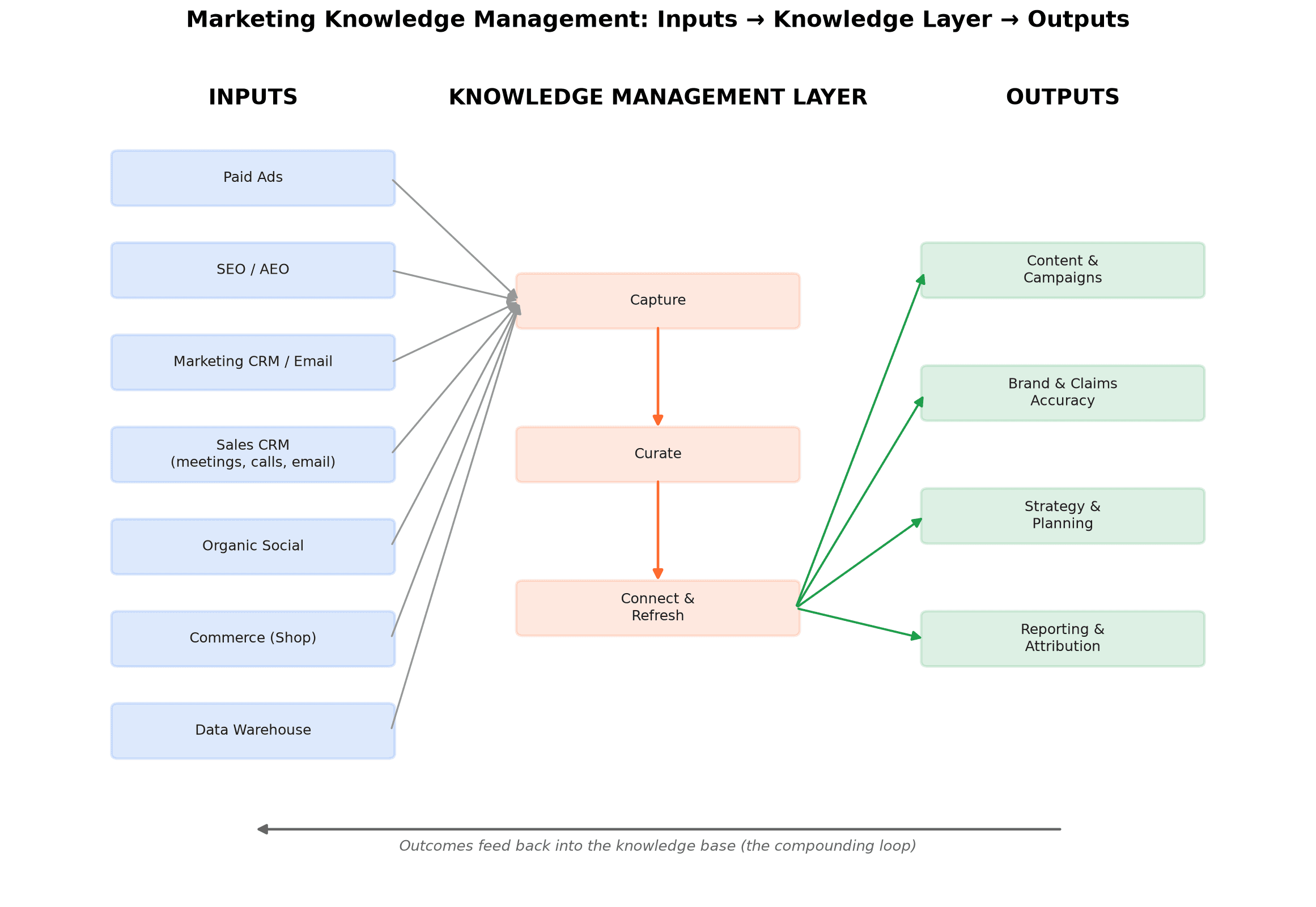
Flowchart explaining which knowledge inputs flow into the knowledge management layer which then flows out into ouputs that then feed back into the knowledge base


Who should actually own it

There isn't one right answer here, but there are three realistic models, and "nobody" is the fourth, most common answer in practice, which is the actual failure mode this whole guide exists to fix.

Solo or lean team (1-5 people). The founder or head of marketing owns it by necessity; there's no one else to hand it to, and this is one of the sharpest constraints lean marketing teams run into. A useful trigger checklist for when this stops being optional: you're about to hire your first marketing person, an agency is coming on board, you're being promoted or replaced, or you've just had your own version of the CEO email-versus-social moment. Any one of those is the signal that whatever's in your head needs to be somewhere else.

Mid-market marketing team. Where a marketing ops or RevOps-adjacent function already exists, ownership should sit there, not with any single content creator. The job here is curation and governance, not authorship, and it needs someone whose role is explicitly cross-functional, checking that what's captured is actually being kept current and actually being used.

Agency context. This is where the ownership question gets sharpest: does the agency or the client own the system? The client should always own the system of record, with the agency as a contributor and consumer of it, precisely because agency turnover is one of the highest-frequency knowledge-loss events a brand goes through. If the knowledge lives inside the agency's own files, it walks out the door when the contract ends.


Where it should live

This is the section most likely to read like a pitch if it's handled carelessly, so start with the requirements, independent of any vendor, before naming anything specific. A system that actually does this job needs to be:

  • Connected, not siloed by document type. Brand history, competitive intelligence, customer evidence, and campaign performance need to sit in relation to each other, not in separate folders that never touch.

  • Continuously fed by external signal, not a one-time upload. Competitor moves, customer reviews, and market shifts need to flow in on their own, not depend on someone remembering to update a doc.

  • Actually readable and actionable, by the people doing the work and increasingly by the AI agents doing parts of it too, not just searchable by a human who knows the right keyword to try.

That third requirement connects directly to a broader technical idea worth understanding in more depth: the difference between a static document store and what's sometimes called a marketing knowledge graph , a model that stores the relationships between a brand's campaigns, content, and outcomes, rather than isolated records.

This is also the point where it's worth naming what this kind of system actually is, and isn't: a marketing operating system, not another feature stack bolted onto the tools already in use. The requirements above describe a marketing intelligence platform, not a wiki with a search bar.

One real, verifiable example of a system built to meet these three requirements: every DOJO account runs its own knowledge base, scoped to that account's specific products, services, and, for B2B clients, key accounts. It's used to ground content creation and flag on-site claims that have gone stale, backed by a live register of every asset that's been published, chat search across past AI conversations, and a knowledge base that keeps growing on its own: customer evidence, competitor insight, and daily news feeding in without anyone uploading it manually.

That knowledge base isn't a passive archive either. It's what pre-built workflows read from and write back to when they run: a content workflow pulls the brand's current positioning and past published articles before drafting, an SEO workflow checks its findings against what was already known about a competitor last month, a claims-audit workflow flags a stale figure on the website against what the knowledge base says is current.

Mapped back to the systems table above, this is what "connected, not siloed" actually looks like in one working implementation: channel connections read the paid, SEO, CRM, social, and commerce data directly, dedicated research agents continuously scan competitors, reviews, and the news cycle instead of waiting for a manual audit, and the sales-CRM connection pulls in meetings, calls, and email activity, not just deal stage, so the language a prospect actually used on a call can ground a piece of content weeks later instead of dying in a transcript nobody reopens.

This is DOJO's specific implementation of the requirements above, sometimes referred to internally as a living graph, and it's worth being honest about what that is and isn't: it's one implementation, not the only possible one. A disciplined team could hand-build a version of this in Notion or Confluence today. It would just require constant manual maintenance that a system built to ingest signal automatically doesn't need.

If you want the underlying technical concept in more depth, that's the marketing knowledge graph piece linked above. If you want to see one specific implementation of it, that's the living graph piece. Either way, the point stands on its own without a product attached to it: the requirements come first, and any specific system, DOJO's or otherwise, gets judged against them.


If you're already running DOJO

The requirements above aren't theoretical for an existing account, they map onto specific workflows already running against your own connected channels and knowledge base. Each of the links below opens directly in the DOJO app and requires you to be logged in to your account [if you don't have an account yet, book a demo]:


Knowledge category

Workflow

What it does for your knowledge system

Competitive intelligence

Competitor Intelligence Suite

Continuously tracks named competitors' moves and writes findings back to your knowledge base instead of a one-off deck

Customer evidence

Customer Evidence and Reviews Suite

Pulls real review and feedback language into the knowledge base so campaigns can be grounded in actual customer words

Sales CRM (meetings, calls, email)

CRM Funnel Analysis

Reads pipeline, deal, and activity data from your connected CRM so marketing can see what sales is actually hearing

Market and industry signal

Daily Industry News Monitor

Feeds daily news and market movement into the knowledge base automatically, the "continuous ingestion" principle from step 4, running on autopilot

Brand and media mentions

Media Monitoring and PR Intelligence

Tracks press and brand mentions as they happen, rather than relying on someone remembering to check

Campaign and creative performance

Daily Paid Media Review and Weekly Paid Media Review

Keep paid performance history current in the knowledge base instead of living in a monthly slide deck

Content and brand history

Content Pillar Development and Advanced SEO Content Creation

Draft new content grounded in what's already been published and positioned, closing the CEO email-versus-social gap from the opening

Cross-channel synthesis

Marketing Command Centre

Reads across paid, SEO, social, and more at once, the "read together, not tab by tab" requirement, in a single running view


The close

The knowledge doesn't have to disappear when someone leaves, when an agency turns over, or when a campaign wraps and the deck gets buried in a shared drive. It has to live somewhere that's actually structured to hold it. That's a discipline first, and a system second.

Organized marketers already know this intuitively: CoSchedule's State of Marketing Strategy research found that marketers who describe themselves as highly organized are 397% more likely to report being successful than those who don't. Knowledge management is what organization looks like once a team is too big, and moves too fast, for one person's memory to be the system.


FAQ

What is marketing knowledge management?

Marketing knowledge management is the practice of capturing, organizing, and continuously updating what a marketing team knows: its brand history, competitive landscape, customer evidence, and campaign outcomes, so that knowledge survives beyond any one person's memory and stays current enough for a team, or an AI agent, to actually act on.

How is a marketing knowledge base different from a customer support knowledge base?

A support knowledge base answers customer questions about the product: what it does, how to use it, how to fix a problem. A marketing knowledge base answers something for the team, not the customer: what's the brand's history on a claim, what are competitors doing right now, what do customers actually say, and what campaigns have already worked or failed, so the team always has current context before making the next decision.

Who should own knowledge management for a marketing team?

It depends on team size. In a solo or lean team, the founder or head of marketing owns it by default. In a mid-market team with a marketing ops or RevOps-adjacent function, ownership should sit there, since the job is curation and governance rather than content creation. In an agency relationship, the client should own the system of record, with the agency contributing to and using it, since agency turnover is a common trigger for knowledge loss.

How do you keep a marketing knowledge base from going stale?

Capture decisions at the moment they're made rather than reconstructing them later, connect the external systems (paid, SEO, CRM, social, commerce data) that generate new information every day rather than relying on manual uploads, and set a recurring review cadence, quarterly at minimum and after every major campaign, to update what's changed and retire what's no longer true.


Sources cited

  • Deloitte Insights, "Capturing institutional knowledge" / "The $9 trillion knowledge exodus: How organizations can turn baby boomer retirements into a competitive advantage," 2026. deloitte.com

  • CoSchedule, "Why Top Marketers Are 397% More Successful," State of Marketing Strategy research, 2019. coschedule.com

  • Marq (formerly Lucidpress), "Brand consistency: the competitive advantage and how to achieve it," 2026. marq.com (vendor-sponsored research; figures are directional, not independently audited)

  • Atlan, "RAG Accuracy Problems: Why They Happen and How to Fix Them," 2026. atlan.com

Marketing Knowledge Management: What to Capture, Who Owns It, Where It Lives

Luke Costley-White

Adclear and DOJO AI partnership graphic: 'Close the loop on agentic marketing. Compliance at the speed of creation.'
温故知新
Review the old to know the new

Your CEO forwards you an email. Then a screenshot of a social post that went out the same week. The messaging doesn't match. Nobody lied, nobody missed a brief; two different people just made two reasonable, disconnected decisions, because neither of them could see what the other had already decided.

A new hire starts on Monday. By Thursday, most of their onboarding time has gone into a scavenger hunt: which Slack channel has the brand voice doc, which Google Drive folder has the "real" positioning deck (there are three), who actually knows why the last rebrand happened.

An analyst spends three days re-running a competitive analysis, confident nobody's done it before. Then someone finds the deck: it exists, it's good, it's eight months old, and it was buried in a folder nobody thought to search.

None of these are knowledge management failures in the abstract sense. They're specific, recurring, expensive moments where a marketing team already had the answer and couldn't find it, or never wrote it down at all. This guide is about fixing that: what to capture, how to set it up, who should own it, and where it should actually live.


Why marketing needs its own kind of knowledge management

The instinct, once a team feels this pain, is to reach for a knowledge base tool: Confluence, Notion, maybe the knowledge base feature already sitting inside HubSpot. That instinct isn't wrong, but it solves the wrong layer of the problem, because a marketing knowledge base is answering a different question than a customer support knowledge base.

A support knowledge base exists to answer: what does the customer need to know about our product? It's built around consistent, repeatable answers to a fixed set of questions.

A marketing knowledge base needs to answer something structurally different: what does the team need to know about the world around the brand, right now, to make the next decision well? That's not a fixed set of questions with fixed answers. It's four categories of knowledge, none of which a generic knowledge base tool is built around:

  • Brand history. What's been claimed, positioned, and said before, so the next campaign doesn't contradict it.

  • Competitive intelligence. What rivals are actually doing, and whether it matters.

  • Customer evidence. Real reviews, objections, and language customers actually use, not what the team assumes they'd say.

  • Campaign and creative performance history. What actually worked, and why, not just what ran.

That's urgent, not a nice-to-have, for a simple reason: this kind of judgment lives almost entirely in people's heads, and people leave. Deloitte's 2026 Global Human Capital Trends research describes a "$9 trillion knowledge exodus," tied to the wave of Baby Boomer retirements taking institutional knowledge with them as they go. Marketing teams aren't exempt from that math; if anything, marketing roles turn over faster than most.

The most visible symptom of this is brand inconsistency, and the numbers on it are stark. Research from Marq (formerly Lucidpress) found that 85% of organizations have brand guidelines, but only around 30% enforce them consistently. Worth flagging honestly: that's vendor-sponsored research from a brand-templating company, not an independently audited academic study, so treat the exact figures as directional rather than gospel. But the gap they're describing is real and easy to recognize: the guideline exists in a PDF is one problem. The guideline gets surfaced at the exact moment someone is writing an ad is a completely different problem, and only a live, connected system solves the second one.

This is where the trap closes on the generic-tool instinct. Confluence, Notion, and a company's own HubSpot knowledge base are genuinely good at storing documents. None of them are built to notice that a competitor just repositioned, that a customer review just contradicted a claim on the pricing page, or that last quarter's campaign taught something relevant to the brief being written today, because none of them are watching anything. They're libraries. A library only helps if someone remembers to walk in, and the value of connected knowledge is that it compounds instead of resetting every time someone forgets .


What actually belongs in a marketing knowledge system

Before "how to build it," it's worth being specific about what's actually being built, because most advice on this topic skips straight to tooling and never defines the object.

Brand history means the decisions, not just the deliverables: why the last five campaigns were positioned the way they were, what got tested and rejected, what the brand has already promised and can't contradict. This is the piece that closes the CEO's email-versus-social gap from the opening: if the last five campaigns' messaging decisions lived in one place, that gap never opens, because whoever wrote the social post would have seen what the email already said.

Competitive intelligence means what a rival changed and whether it's actually relevant, not a quarterly slide deck that's stale before it's presented. A pricing page update, a repositioning, a new feature launch: each is a small, timely fact, and the value is in catching it close to when it happens.

Customer evidence means the actual words customers use: objections from sales calls, language from reviews, the phrase a prospect used that the team would never have written themselves. This is consistently the most valuable and most siloed input in a marketing organization, because it lives inside conversations marketing usually never hears.

Campaign and creative performance history means what worked and why, tied to the actual creative and the actual audience, not a generic "email works well for us" takeaway. The "why" is the part that gets lost first: six months later, someone remembers that a campaign did well, but not which specific line, offer, or audience made the difference.

Notice what's true of all four: none of this requires DOJO, or any specific vendor, to exist. A disciplined team could build a version of this today with a shared document and real habits. That's the point. The system comes later. The categories are the actual object being managed.


How to actually set it up

This is a sequence, not a tool purchase.

1. Audit before you build. Find out what already exists, where it lives, and whose head it's actually in. Most teams are surprised by how much they already have scattered across decks, Slack threads, and one person's memory; the problem usually isn't a lack of knowledge, it's that none of it is in one place.

2. Capture at the moment of creation, not after the fact. The single best habit a marketing team can build here is writing down the decision while it's being made, not reconstructing it later from memory. A one-line note in the campaign brief ("we're avoiding this claim because of X") takes ten seconds and saves someone else three days six months from now.

3. Structure around the four knowledge categories, not around channels or teams. Most knowledge bases get organized by document type (decks, briefs, guidelines) or by department (paid, content, brand). Neither structure matches how a decision actually gets made. Organize around brand history, competitive intelligence, customer evidence, and campaign performance instead, because that's the shape of the question someone is actually asking when they go looking.

4. Build in continuous external ingestion, not a one-time upload. A knowledge base populated once and left alone starts decaying immediately: competitor moves (this is what proactive competitive intelligence is actually for), customer reviews, and market signals need to keep flowing in on their own, or the system is stale within a quarter. This is where a lot of "AI-powered" knowledge tools quietly fail: research from Atlan, a data-context platform that studies this specifically, found that roughly 80% of enterprise RAG (retrieval-augmented generation) deployments, the kind of AI search sitting on top of most document stores, fail to perform reliably in production, and the failures trace back to what's being retrieved, not the underlying model. A system that looks intelligent but is just searching a pile of increasingly outdated documents will produce confident, wrong answers, and a knowledge base with nothing reading and acting on it, no proactive AI marketing agents , is just a library with better search.

5. Review and retire on a cadence. Set a recurring check, quarterly at minimum, and a lighter one after every major campaign: fifteen minutes to update what changed, retire what's no longer true, and flag what's missing. Knowledge that never gets reviewed becomes the digital junk drawer every unmaintained knowledge base eventually turns into.

Which systems actually need to be connected

Step four above, continuous external ingestion, is a principle. Here's what it actually means in practice, because most of what a marketing team needs to know isn't written down anywhere. It's sitting inside eight or nine disconnected platforms, updating every day, that nobody is systematically reading.


System / channel

What it contributes to the knowledge system

Why a document can't replace it

Paid ads (Google Ads, Meta Ads, LinkedIn Ads)

Campaign, ad set, and creative-level performance; what's actually converting versus what's just running

Performance shifts daily; a quarterly deck showing "what worked" is stale before the next campaign launches

SEO (Search Console, rankings, backlinks, technical health)

What the brand ranks for, what's slipping, where competitors are gaining ground, technical issues suppressing visibility

Rankings move weekly; a static SEO audit from six months ago actively misleads the next content brief

AEO / AI search visibility

Whether AI answer engines (ChatGPT, Perplexity, Gemini) cite the brand, and where competitors are winning citations instead

This category barely existed 18 months ago; there's no legacy document to be out of date, the knowledge has to be captured live or not at all

Marketing CRM / email (e.g. Klaviyo)

Campaign and flow performance, list health, deliverability, what messaging is actually landing with subscribers

Segment behavior and deliverability reputation change continuously; a "what our audience responds to" doc is an opinion until it's checked against live send data

Sales CRM (e.g. HubSpot, Clarify) including meetings, calls, and email activity

Real buyer language, objections, and the actual reasons deals win or stall, straight from the conversations sales is having

This is the single most valuable and most commonly siloed input; marketing routinely writes messaging with zero visibility into what prospects actually say on sales calls

Organic social

What content resonates, what tone and topics the audience engages with, competitor and community conversation

A content calendar reflects intent; social performance and listening data reflect reality, and the two drift apart within weeks

Commerce / shop data (e.g. Shopify)

Real revenue, order, and customer behavior tied back to campaigns, not just clicks and impressions

Without this, "marketing knowledge" stops at the click and never learns what actually drove revenue

Data warehouse (e.g. BigQuery)

Whatever first-party data the business already centralizes: revenue, product usage, customer records, joined against marketing activity

This is often the most accurate, least biased version of "what actually happened" that already exists; a knowledge system that ignores it works from a worse copy of the truth the company already owns

Connecting these systems isn't the same as having a dashboard for each one. A dashboard answers "what happened in this channel." A connected knowledge system answers a harder question: given everything happening across every channel, what does the team need to know right now to make the next decision well? That requires reading the systems together, not tab by tab.

This is also where most attempts at "connecting everything" quietly fail, in the same way described above: the connection is a one-time export into a spreadsheet or a slide, not a live read. Six months later, that export is just a slightly more organized version of the same stale archive.

The shape of the whole system, once it's actually wired up, looks less like a document library and more like a loop: signals come in from every channel, get captured and curated into a connected knowledge layer, and flow back out into the work that channel actually needs done, with outcomes feeding back in to keep the whole thing current.

Flowchart explaining which knowledge inputs flow into the knowledge management layer which then flows out into ouputs that then feed back into the knowledge base


Who should actually own it

There isn't one right answer here, but there are three realistic models, and "nobody" is the fourth, most common answer in practice, which is the actual failure mode this whole guide exists to fix.

Solo or lean team (1-5 people). The founder or head of marketing owns it by necessity; there's no one else to hand it to, and this is one of the sharpest constraints lean marketing teams run into. A useful trigger checklist for when this stops being optional: you're about to hire your first marketing person, an agency is coming on board, you're being promoted or replaced, or you've just had your own version of the CEO email-versus-social moment. Any one of those is the signal that whatever's in your head needs to be somewhere else.

Mid-market marketing team. Where a marketing ops or RevOps-adjacent function already exists, ownership should sit there, not with any single content creator. The job here is curation and governance, not authorship, and it needs someone whose role is explicitly cross-functional, checking that what's captured is actually being kept current and actually being used.

Agency context. This is where the ownership question gets sharpest: does the agency or the client own the system? The client should always own the system of record, with the agency as a contributor and consumer of it, precisely because agency turnover is one of the highest-frequency knowledge-loss events a brand goes through. If the knowledge lives inside the agency's own files, it walks out the door when the contract ends.


Where it should live

This is the section most likely to read like a pitch if it's handled carelessly, so start with the requirements, independent of any vendor, before naming anything specific. A system that actually does this job needs to be:

  • Connected, not siloed by document type. Brand history, competitive intelligence, customer evidence, and campaign performance need to sit in relation to each other, not in separate folders that never touch.

  • Continuously fed by external signal, not a one-time upload. Competitor moves, customer reviews, and market shifts need to flow in on their own, not depend on someone remembering to update a doc.

  • Actually readable and actionable, by the people doing the work and increasingly by the AI agents doing parts of it too, not just searchable by a human who knows the right keyword to try.

That third requirement connects directly to a broader technical idea worth understanding in more depth: the difference between a static document store and what's sometimes called a marketing knowledge graph , a model that stores the relationships between a brand's campaigns, content, and outcomes, rather than isolated records.

This is also the point where it's worth naming what this kind of system actually is, and isn't: a marketing operating system, not another feature stack bolted onto the tools already in use. The requirements above describe a marketing intelligence platform, not a wiki with a search bar.

One real, verifiable example of a system built to meet these three requirements: every DOJO account runs its own knowledge base, scoped to that account's specific products, services, and, for B2B clients, key accounts. It's used to ground content creation and flag on-site claims that have gone stale, backed by a live register of every asset that's been published, chat search across past AI conversations, and a knowledge base that keeps growing on its own: customer evidence, competitor insight, and daily news feeding in without anyone uploading it manually.

That knowledge base isn't a passive archive either. It's what pre-built workflows read from and write back to when they run: a content workflow pulls the brand's current positioning and past published articles before drafting, an SEO workflow checks its findings against what was already known about a competitor last month, a claims-audit workflow flags a stale figure on the website against what the knowledge base says is current.

Mapped back to the systems table above, this is what "connected, not siloed" actually looks like in one working implementation: channel connections read the paid, SEO, CRM, social, and commerce data directly, dedicated research agents continuously scan competitors, reviews, and the news cycle instead of waiting for a manual audit, and the sales-CRM connection pulls in meetings, calls, and email activity, not just deal stage, so the language a prospect actually used on a call can ground a piece of content weeks later instead of dying in a transcript nobody reopens.

This is DOJO's specific implementation of the requirements above, sometimes referred to internally as a living graph, and it's worth being honest about what that is and isn't: it's one implementation, not the only possible one. A disciplined team could hand-build a version of this in Notion or Confluence today. It would just require constant manual maintenance that a system built to ingest signal automatically doesn't need.

If you want the underlying technical concept in more depth, that's the marketing knowledge graph piece linked above. If you want to see one specific implementation of it, that's the living graph piece. Either way, the point stands on its own without a product attached to it: the requirements come first, and any specific system, DOJO's or otherwise, gets judged against them.


If you're already running DOJO

The requirements above aren't theoretical for an existing account, they map onto specific workflows already running against your own connected channels and knowledge base. Each of the links below opens directly in the DOJO app and requires you to be logged in to your account [if you don't have an account yet, book a demo]:


Knowledge category

Workflow

What it does for your knowledge system

Competitive intelligence

Competitor Intelligence Suite

Continuously tracks named competitors' moves and writes findings back to your knowledge base instead of a one-off deck

Customer evidence

Customer Evidence and Reviews Suite

Pulls real review and feedback language into the knowledge base so campaigns can be grounded in actual customer words

Sales CRM (meetings, calls, email)

CRM Funnel Analysis

Reads pipeline, deal, and activity data from your connected CRM so marketing can see what sales is actually hearing

Market and industry signal

Daily Industry News Monitor

Feeds daily news and market movement into the knowledge base automatically, the "continuous ingestion" principle from step 4, running on autopilot

Brand and media mentions

Media Monitoring and PR Intelligence

Tracks press and brand mentions as they happen, rather than relying on someone remembering to check

Campaign and creative performance

Daily Paid Media Review and Weekly Paid Media Review

Keep paid performance history current in the knowledge base instead of living in a monthly slide deck

Content and brand history

Content Pillar Development and Advanced SEO Content Creation

Draft new content grounded in what's already been published and positioned, closing the CEO email-versus-social gap from the opening

Cross-channel synthesis

Marketing Command Centre

Reads across paid, SEO, social, and more at once, the "read together, not tab by tab" requirement, in a single running view


The close

The knowledge doesn't have to disappear when someone leaves, when an agency turns over, or when a campaign wraps and the deck gets buried in a shared drive. It has to live somewhere that's actually structured to hold it. That's a discipline first, and a system second.

Organized marketers already know this intuitively: CoSchedule's State of Marketing Strategy research found that marketers who describe themselves as highly organized are 397% more likely to report being successful than those who don't. Knowledge management is what organization looks like once a team is too big, and moves too fast, for one person's memory to be the system.


FAQ

What is marketing knowledge management?

Marketing knowledge management is the practice of capturing, organizing, and continuously updating what a marketing team knows: its brand history, competitive landscape, customer evidence, and campaign outcomes, so that knowledge survives beyond any one person's memory and stays current enough for a team, or an AI agent, to actually act on.

How is a marketing knowledge base different from a customer support knowledge base?

A support knowledge base answers customer questions about the product: what it does, how to use it, how to fix a problem. A marketing knowledge base answers something for the team, not the customer: what's the brand's history on a claim, what are competitors doing right now, what do customers actually say, and what campaigns have already worked or failed, so the team always has current context before making the next decision.

Who should own knowledge management for a marketing team?

It depends on team size. In a solo or lean team, the founder or head of marketing owns it by default. In a mid-market team with a marketing ops or RevOps-adjacent function, ownership should sit there, since the job is curation and governance rather than content creation. In an agency relationship, the client should own the system of record, with the agency contributing to and using it, since agency turnover is a common trigger for knowledge loss.

How do you keep a marketing knowledge base from going stale?

Capture decisions at the moment they're made rather than reconstructing them later, connect the external systems (paid, SEO, CRM, social, commerce data) that generate new information every day rather than relying on manual uploads, and set a recurring review cadence, quarterly at minimum and after every major campaign, to update what's changed and retire what's no longer true.


Sources cited

  • Deloitte Insights, "Capturing institutional knowledge" / "The $9 trillion knowledge exodus: How organizations can turn baby boomer retirements into a competitive advantage," 2026. deloitte.com

  • CoSchedule, "Why Top Marketers Are 397% More Successful," State of Marketing Strategy research, 2019. coschedule.com

  • Marq (formerly Lucidpress), "Brand consistency: the competitive advantage and how to achieve it," 2026. marq.com (vendor-sponsored research; figures are directional, not independently audited)

  • Atlan, "RAG Accuracy Problems: Why They Happen and How to Fix Them," 2026. atlan.com

Join over 100+ brands
already growing with us.

Join over 100+ brands
already growing with us.

FAQ

Frequently asked questions

Frequently asked questions

What is DOJO AI?

DOJO is an intelligent marketing system that watches every channel continuously, builds a living knowledge graph of your brand's marketing reality, and deploys specialised agents that execute work autonomously before you've had to ask. Not a tool. Not a platform. A system. Every signal your brand produces flows in, every action feeds back, and the system compounds its understanding over time. Most marketing software gives you data. DOJO gives you a system of record, context, and execution: one place where everything is captured, connected, and acted on. Instead of switching between Google Ads, Meta, LinkedIn, GA4, and social dashboards, you get one intelligent system that shows you what's working across all channels - and tells you exactly what to do about it. Specialized AI agents analyze your campaigns 24/7, identify opportunities competitors miss, and help you move faster than companies 10x your size.

Who is DOJO built for?

DOJO is built for marketing teams that want to spend their time on decisions that require human judgment, not on tasks that don't. If your team is stretched across too many channels, too many tools, and too many reports, DOJO replaces the operational burden with a system that runs continuously and arrives with work already done. It's used by in-house marketing teams, agencies managing multiple client accounts, and founders who want the output of a full marketing department without the overhead of one.

Is DOJO suitable for marketing agencies?

Yes. Agencies are one of DOJO's core use cases. The system connects across multiple client accounts, automates reporting and content production, and runs campaign monitoring continuously — so account managers spend time on client relationships and strategy, not on manual tasks that don't require their judgment. DOJO builds a separate knowledge graph for each client, so every recommendation and every piece of content is grounded in that client's actual brand history, not generic best practice.

How does DOJO work with existing tools?

DOJO connects to your existing channels through proprietary connectors and a live web crawler. Google Ads, Meta, LinkedIn, your website, brand mentions, competitor movements — everything flows in automatically, with no manual pulls required. You don't have to replace your stack to use DOJO. The system reads your existing data, connects it, and builds context on top of it. Over time, that context becomes the foundation for every recommendation and every action DOJO takes on your behalf.DOJO builds a separate knowledge graph for each client, so every recommendation and every piece of content is grounded in that client's actual brand history, not generic best practice.

What ROI can I expect?

DOJO customers typically see measurable cost reductions and efficiency gains within the first 90 days, with outcomes compounding as the system builds context over time. Here's what customers have reported: 79% drop in cost per acquisition(Morningstar) 3x conversion volumein the same 23-day window (Morningstar) 40% drop in acquisition costs(Broadvoice) 15x faster marketing reporting(Ozone API) 3x more efficient Google Adsquarter over quarter (Ecologi) 290% increase in content output(Broadvoice) 20 hours saved per month, returned to strategy (Morningstar) The compounding effect matters here. The longer DOJO runs, the more context it builds, and the more precisely it acts. Early results are strong; they get better.

How does DOJO compare to HubSpot, Jasper, or other AI marketing tools?

Most AI marketing tools fall into one of two categories: workflow automation (HubSpot, Marketo, ActiveCampaign) that executes campaigns you set up, or content generation (Jasper, Copy.ai) that produces copy on demand. Both share the same limitation: they start from scratch every session. No memory of your brand history, your previous campaigns, or what your competitors have been doing. DOJO maintains a continuously updated knowledge graph of your entire marketing reality and runs specialised agents that read it daily, surface what needs attention, and execute work before you've asked. The longer DOJO runs, the more precisely it acts — because it compounds what it learns about your specific brand, market, and competitors. If you're evaluating options: Email and workflow automation: HubSpot, Klaviyo, Marketo AI content writing: Jasper, Copy.ai A system that watches every channel, builds brand context, and executes proactively: DOJO

Does AI marketing software actually improve over time, or does it reset every session?

Most AI marketing software resets every session. It has no memory of your brand, your campaigns, or what worked before. Every interaction starts from a blank slate. DOJO works differently. Every signal it captures, every workflow it runs, every recommendation it makes is fed back into the DOJO Graph. The system learns what works for your specific brand, in your specific market, against your specific competitors. It builds institutional knowledge that no other system carries. A team that's been using DOJO for six months has a system that understands their brand history, their campaign patterns, and their market in detail. That depth of context changes what the agents can do. The advantage grows every day the system runs, and it never stops running.

How does DOJO handle data security and privacy?

DOJO is built on enterprise-grade infrastructure with security and data privacy at its core. Your brand data, campaign history, and knowledge graph are kept entirely separate from other customers' data. For detailed information on data handling, storage, and compliance, see our Privacy Policy and Data Processing Agreement, or speak to our team directly when you book a demo.