Time to value: 15 minutes to read, one framework you can start using this week
Who this is for: Owners and ops leads at 5-50 person agencies who want the next account without the next hire
The math that's capping your margin
Take a look at how your agency actually grows. A new account lands. Someone has to run it: pull the data, write the report, keep the client's socials moving, chase the next pitch. So you hire, or you stretch an existing account manager thinner. Either way, headcount rises with accounts, roughly one for one.
That ratio is the ceiling on your margin, not client churn, not pricing, not competition. Every agency that has hit a growth plateau has hit this one first. You can win the 11th account. What you can't do, on the current setup, is run it without something close to an 11th account's worth of new hire.
The instinct is to treat this as a hiring problem: get faster at recruiting, get better at onboarding, build a bench. That helps, but it doesn't change the ratio. It just makes the ratio less painful to execute.
The actual fix is to change what "running an account" costs in hours, so the ratio itself loosens. Three parts of account delivery eat almost all of that time: client reporting, new business prospecting, and keeping your own agency's content moving. All three are highly repeatable. Repeatable work is exactly the kind of work you can template once and run many times, which is the whole idea behind decoupling account count from headcount.
Below are the three systems, the time each one already frees up once it's templated, and what that time is worth in account capacity, not just hours back.
System 1: The 3-metric reporting system
What breaks the ratio: Comprehensive client reports take hours to build and clients skim them in minutes before asking, "so what do we do?" Every extra client means another report cycle, another set of screenshots, another Tuesday afternoon gone.
The fix: Stop reporting on everything. Report exactly three things, every client, every time.
CLIENT MONTHLY REPORT
Reporting Period: [Month]
PROGRESS Goal: [Their stated objective]
Current: [Where we are]
Gap: [Specific delta]
PERFORMANCE
What Worked: [Top performing channel/tactic]
What Didn't: [Underperforming area]
Why: [One-line data-backed reason]
PRIORITY
Next Action: [Single most important thing to do]
Expected Impact: [What this changes]
Timeline: [When it gets done]
A full branded example of this report, filled in with a real (illustrative) client scenario, is available as a companion asset: The dojo Agency Client Report Template. It shows exactly which data sources feed each line, connected ad platforms, CRM, email platform, so the account lead never has to build the report from scratch, only fill in the “so what.”

An imaginary dojo Agency client report, filled in. Every line shows exactly where the data came from.
Once this template exists, every account manager uses the same structure. No one argues over which of 47 metrics to include. The client gets clarity in under a minute, and the report stops being a research project.
Capacity read: this saves 4-5 hours per client, per month. That's not spare time to fill with more coffee breaks. It's 4-5 hours per account you were previously spending just to keep an existing client informed, now available to service another one.
System 2: The pattern-match prospecting system
What breaks the ratio: New business is what lets you add accounts at all, but research alone takes 60-90 minutes per prospect before you can write anything worth sending. At that rate, a proper prospecting push competes directly with the account work you're already stretched thin on, so it loses, and the pipeline goes quiet.
The fix: Most of that research keeps rediscovering the same 5-7 problem patterns your agency already knows how to solve. Document them once.
CLIENT: [Name]
INDUSTRY: [Sector]
PROBLEM PATTERN: [What wasn't working]
SOLUTION: [What you did] OUTCOME: [Quantified result]
SIGNAL: [How you'd spot this problem externally]
Example:
PATTERN: Paid ads working, attribution broken
SIGNAL: LinkedIn posts about CAC, CFO pressure, attribution debates
CASE: [Client name], fixed attribution, proved ROAS, saved $200K budget
When a new prospect shows up, you're not starting research from zero. You're scanning their LinkedIn, website, and job posts for a signal that matches a pattern you've already solved, then pulling the matching case:
Saw your post about [signal].
We solved this for [similar company]: [specific outcome].
Worth 15 minutes?
A full branded pitch deck template exists as a companion asset: The dojo Agency Pitch Deck Template. It’s 8 slides, each one tagged with exactly where the underlying data would come from, pattern library, competitor monitoring, SEO/AEO snapshots, so a rep isn’t starting a deck from a blank page either.
Capacity read: this drops research time from 60-90 minutes per prospect to 10-15 minutes, saving 40-60 minutes per prospect. New business stops requiring a dedicated hire to run consistently. One person, working the pattern library, can now cover the prospect volume that used to need a part-time researcher.
System 3: The rolling content calendar
What breaks the ratio: Client work always wins the calendar, so the agency’s own marketing goes dark for weeks, then bursts back to life right before someone remembers new business needs a pipeline. There’s no consistent proof of your own expertise for prospects to find, and no strong personal brand for your founders or leads to point to.
The fix: A rolling 30-day calendar that replenishes itself, instead of a batch you eventually run out of.
Step 1: Theme your month
THEME 1: [Your methodology]
THEME 2: [Client results]
THEME 3: [Industry perspective]
THEME 4: [Founder/team insights]
Step 2: Set the cadence
Monday: insight post (methodology)
Wednesday: case post (results)
Friday: hot take (perspective)
Step 3: Build the rolling structure
WEEK 1
- Mon [Theme]: [Topic]
- Wed [Theme]: [Topic]
- Fri [Theme]: [Topic]
WEEK 2
[Repeat structure with new topics]
BUFFER POSTS (Pre-written)
- Post 1: [Topic]
- Post 2: [Topic]
- Post 3: [Topic]
The rule that makes it self-sustaining: when you publish a post, draft its replacement immediately. You’re always 30 days ahead plus a small buffer, so a busy client week never empties the calendar.
Capacity read: this saves 15-20 hours per month at the agency level. That’s time no single account manager was billing to a client anyway; it was going to your own marketing in unpredictable bursts. Templated, it becomes a fixed, small weekly cost instead of a recurring emergency.
What this actually looks like
Here’s what a rolling 30 days looks like in practice, for an illustrative agency we’re calling The dojo Agency: the Monday, Wednesday, Friday cadence, with a real example post topic for each format, insight, case, hot take.
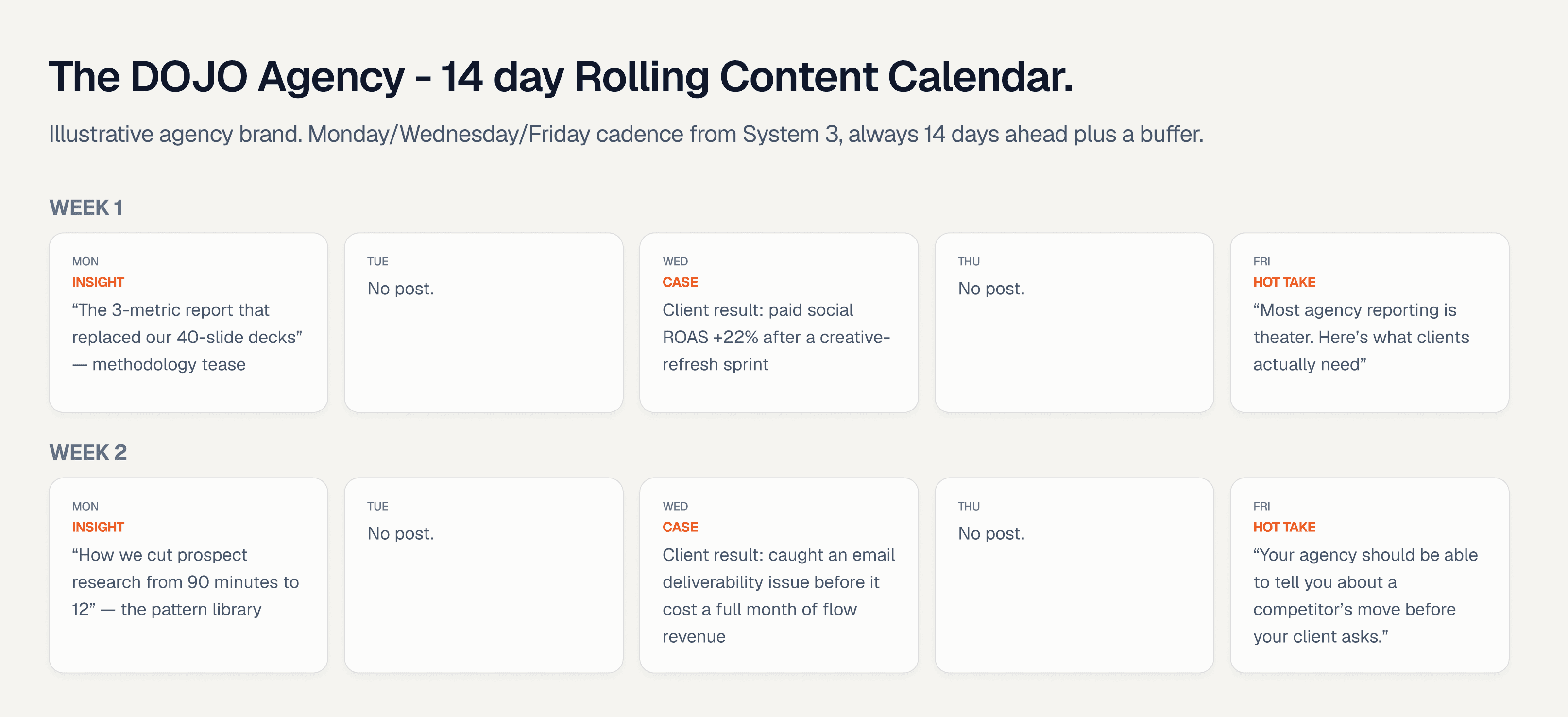
The dojo Agency’s 14-day rolling content calendar: Monday/Wednesday/Friday cadence across insight, case, and hot-take formats
Reach isn't the metric that matters most here. The chart below shows how to read format performance properly: which format gets the most reach versus which one actually converts to replies and DMs, so the calendar doesn't end up chasing likes.
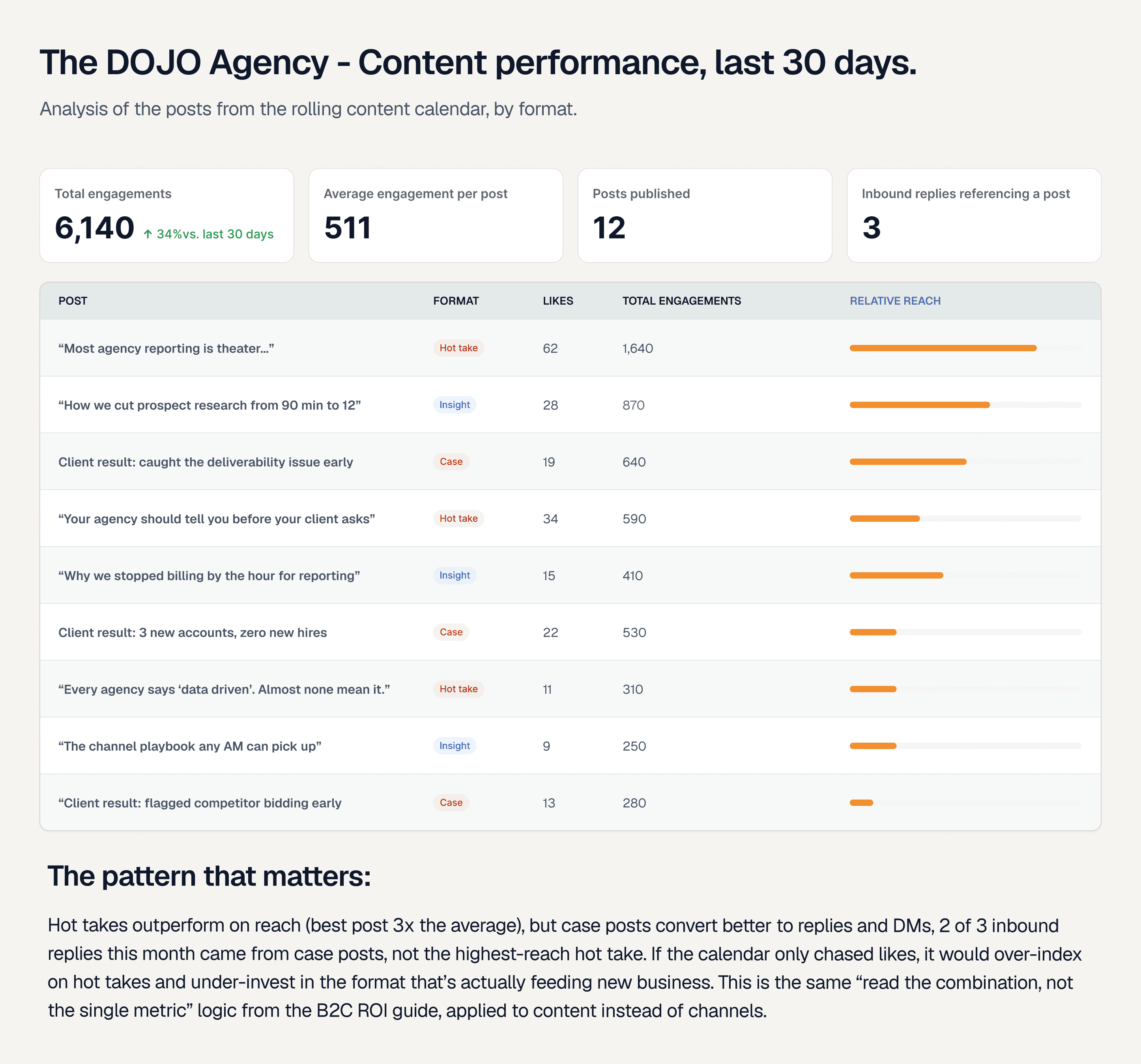
Which post format actually drives replies and DMs, not just likes.
Two things the three systems don’t cover yet: risk and repeatability
Warning-signal monitoring. The three systems above make existing work faster, but none of them catch a problem before it becomes one. A weekly check for competitor and brand-intelligence signals, a competitor increasing spend on a client’s branded terms, a sentiment shift, a category share-of-voice change, catches risk early enough to act on it, for the client’s business and for the agency’s own retention. This is the difference between a report that explains what already happened and one that also flags what’s about to.
Channel playbook documentation. Every account manager tends to reinvent “what we check on this channel” from memory. Documenting each channel’s playbook once, what to research, what to analyze, what questions to ask of the data, means any account manager can pick up any account without relying on one person’s tribal knowledge. It’s the same fix as the pattern library in System 2, applied to channel operations instead of prospecting.
Both matter for the capacity math below. Freed hours only compound if the work reinvested into new accounts doesn’t also require rebuilding tribal knowledge and risk-checking from scratch every time. Skip these two, and the hours you free up on reporting, prospecting, and content just get spent somewhere else.
The account-capacity math
Add the three systems together and the source frameworks above put total time reclaimed at 40-100 hours per month, agency-wide. Measured against a standard working month of roughly 160-173 hours, that’s the equivalent of a quarter to a little over half of a full-time role’s monthly hours, recovered without a hire.
Here’s how to turn that into an account number for your own agency, worked through with round figures as an example (swap in your own numbers):
Say you run 10 client accounts.
Reporting: 4-5 hours saved per client, per month, times 10 accounts, is 40-50 hours a month back.
Content: 15-20 hours a month back at the agency level, regardless of account count.
Prospecting: 40-60 minutes saved per prospect. At even 10 prospects worked a month, that’s 7-10 hours back, and it’s the hours that let you pursue the 11th account in the first place.
That’s roughly 60-80 hours a month freed once all three are templated, on a 10-account agency. Turn that into your own account-capacity number with one more step: take your current average hours spent per account per month on reporting, prospecting, and content combined (a rough estimate is fine, most agencies land somewhere between 8-15 hours per account per month on these three tasks alone before templating). Divide your total freed hours by that per-account figure, and you’ve got roughly how many additional accounts the same team can absorb without a new hire.
Run it on this guide’s 10-account example: 60-80 hours freed, divided by, say, 10 hours per account, comes out to 6-8 additional accounts the same team could take on with no new hire. Swap in your own freed-hours total and your own per-account figure, and that division gives you your real number.
The ratio you assumed was fixed (one hire per account) is only fixed if reporting, prospecting, and content stay manual. Template them, and the ratio bends, by an amount you can now actually calculate.
The 30-day rollout
Week 1: Build your templates
Create your 3-metric reporting template
Document 3-5 case patterns from past client work
Set your content themes and cadence
Week 2: Test with one client
Send one 3-metric report
Match one prospect to a pattern and send the outreach
Plan the first 30 days of content
Week 3: Roll out across accounts
Convert every client to the 3-metric report
Finish the full pattern library
Fill the content buffer
Week 4: Measure the time back
Track hours saved on reporting
Track hours saved on prospecting
Track hours saved on content planning
Start with one framework, run it fully across every account, then move to the next. Trying to stand up all three in week one is how agencies abandon frameworks by week two.
A companion visual, “Where Agency Hours Actually Go: Before, Now, Optimized,” lays out a 100%-stacked time-allocation view across three states: fully manual (before), the three systems templated (now), and dojo layered on top with risk monitoring and playbook documentation baked in (optimized). Reporting and prospecting time shrink, content and strategy time grow, and risk monitoring goes from zero to a standing weekly check.
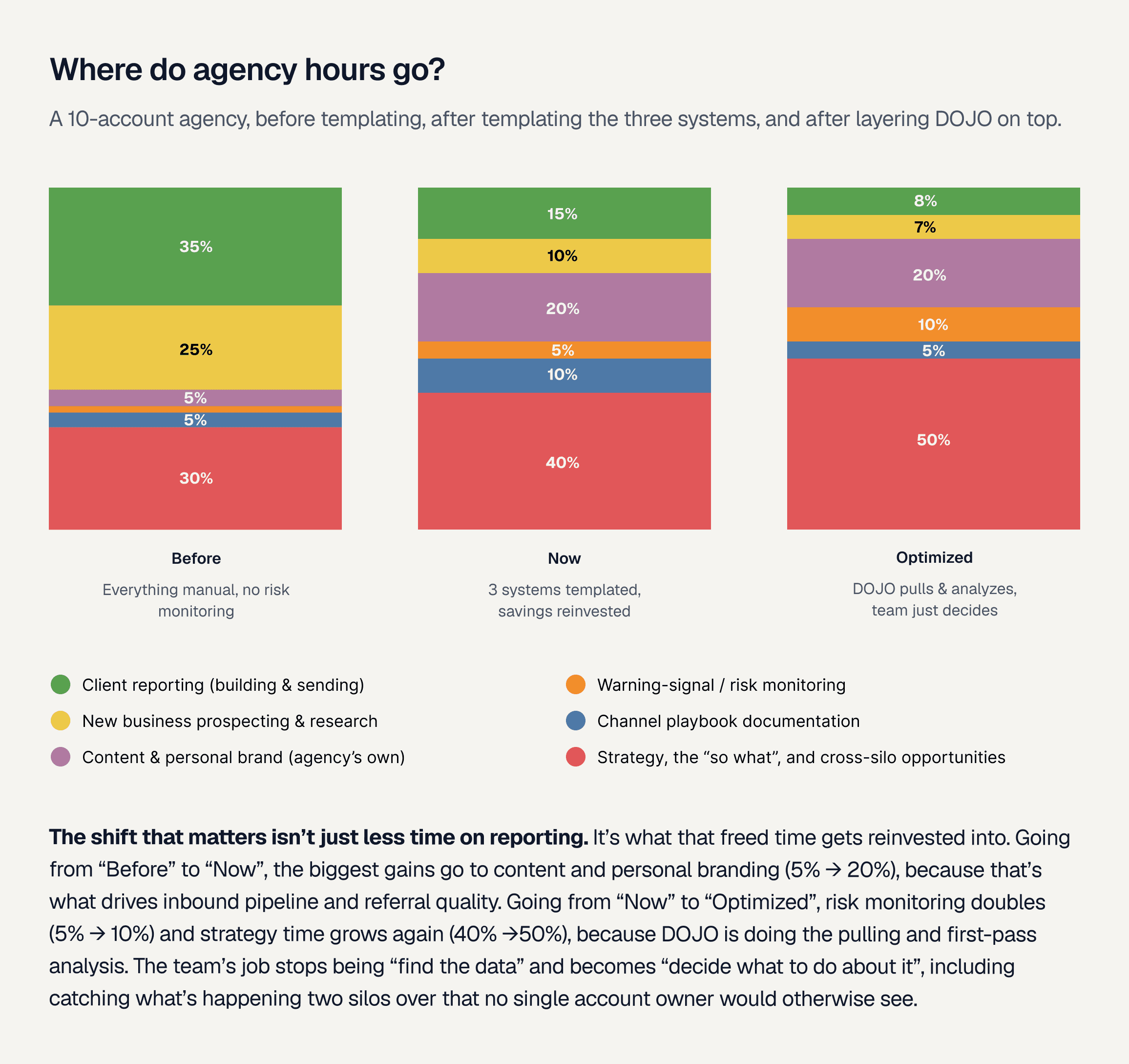
Where agency hours actually go: before, after templating, and after layering dojo on top.
Where this stops being manual
All three systems work in Google Docs, Notion, or Airtable, and plenty of agencies run them exactly that way. The limit shows up once you’re managing more than a handful of accounts across separate tools: someone still has to pull the data, paste it into the template, match the prospect to the right case, and remember to draft tomorrow’s buffer post.
That’s the layer dojo takes off an operator’s plate, and it’s also what keeps your additional-account-capacity number from shrinking back down. The formula above assumes reporting, prospecting, and content stay templated as you add accounts. Run all three by hand across 15, 20, 30 accounts, and each new one quietly re-adds the manual hours you just freed. dojo pulls connected campaign and account data straight into your report template instead of someone copying it in by hand, matches a prospect’s signals against your case library automatically, and plans content against your themes and voice guidelines so the buffer doesn’t run dry. Same three frameworks, but the per-account hours figure in your formula stays low as you scale, instead of creeping back up account by account.
dojo is also what keeps the risk-monitoring check and the channel playbooks self-maintaining, rather than two more things for the team to remember to do on top of the three systems. It surfaces competitor and brand-intelligence signals automatically instead of someone running a manual weekly search, and keeps playbooks current as channels change instead of relying on whoever documented them last to notice when they go stale.
Agencies already running this way describe it less as a time-saver and more as a different way of working:
“dojo gives us a centralized way to see what’s actually happening across channels without stitching dashboards together.”
-Refine Labs
“The time saved isn’t just ‘2 hours became 15 minutes.’ It’s ‘3 hours of research, false starts, and second-guessing became 15 minutes of confident decision-making.’”
-Andrew Jenkins, Founder at Volterra Digital Marketing Agency
Start with the framework, not the tool. Build the three templates above by hand first, on your own accounts. Once you feel the ratio loosen, you’ll know exactly what to automate and why.

