EU Advertising Fees in 2026: Meta, Google, Amazon Explained | DOJO AI

Luke Costley-White
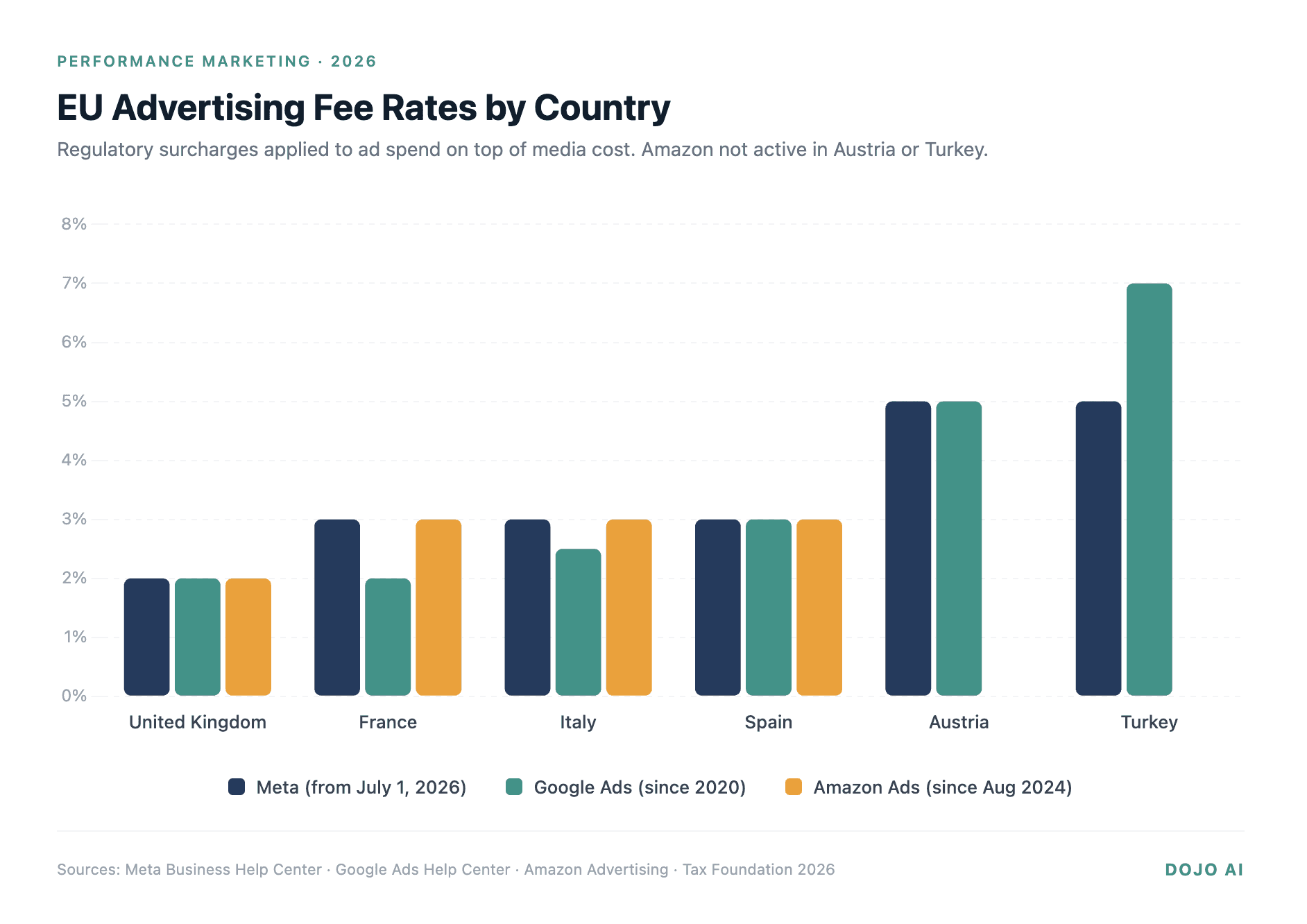
Bar chart showing EU advertising fee rates by country across Meta, Google Ads, and Amazon Advertising in 2026
転嫁の代償
The Cost of Passing the Blame

If you run paid media in Europe, your cost base just changed.

Starting July 1, 2026, Meta adds "location fees" to every campaign delivering impressions in Austria, France, Italy, Spain, Turkey, and the UK. Rates run from 2% to 5% depending on the country. The fee sits on top of your campaign budget, shows up as a separate line on your invoice, and applies based on where your audience is — not where your business is.

This isn't a Meta-only story. Google started doing the same thing in November 2020. Amazon followed in August 2024. The question for lean marketing teams isn't whether to be angry about it. It's whether your budget models, KPI baselines, and reporting are set up to absorb it cleanly — or whether July 1 is going to quietly break your numbers.

Most are not set up. This article walks through what the fees are, why they exist, what they'll actually cost, and the four things you need to fix before the invoices change.

What Are EU Advertising Fees, and Which Platforms Charge Them?

EU advertising fees are regulatory surcharges that ad platforms pass on to advertisers running campaigns in European countries subject to national Digital Services Taxes (DSTs) or significant EU regulatory compliance costs.

The mechanism is consistent across platforms: your campaign spend enters the platform's auction system as normal, the platform buys impressions on your behalf, and then an additional fee calculated as a percentage of spend in the affected country appears on your invoice. The fee is triggered by audience location, not advertiser location.

Current EU advertising fee rates by platform:


Country

Meta (from July 1, 2026)

Google Ads (current)

Amazon Ads (from Aug 2024)

Austria

5%

5%

France

3%

2%

3%

Italy

3%

2.5%

3%

Spain

3%

3%

3%

Turkey

5%

7%

UK

2%

2%

2%

Germany

Bar chart showing EU advertising fee rates by country across Meta, Google Ads, and Amazon Advertising in 2026
Fee rates vary by platform for the same underlying tax liability. France's 3% DST produces a 3% Meta fee and a 2% Google fee — confirming that rate-setting involves commercial judgment, not just cost pass-through.

Two things stand out in this table. First: Google's Turkey rate (7%) is higher than Meta's (5%) for the same underlying DST liability — confirming that fee-setting involves commercial judgment, not just tax pass-through. Second: Germany, Europe's largest advertising market, has no DST and no platform surcharge. For now.

LinkedIn, TikTok, X, Snapchat, and Pinterest have not announced equivalent surcharges as of June 2026. Whether they absorb these costs into base CPMs or haven't structured them as visible line items is unknown. A surcharge announcement from any of these platforms would follow an established pattern, not create a new one.

Why Are These Fees Happening Now?

Three layers of EU regulation have compounded over the past seven years to create a genuine and growing compliance cost for large ad platforms. The fees are how platforms are now passing those costs on.

National Digital Services Taxes

This is the most direct driver. Starting with France in 2019, EU member states began imposing unilateral taxes on the digital revenues of large technology companies. The EU failed to agree on a unified digital tax, so countries moved independently.


Country

DST Rate

In Force Since

France

3%

January 2019

Austria

5%

January 2020

Italy

3%

January 2020

UK

2%

April 2020

Spain

3%

January 2021

Turkey

Various

Various

These taxes apply only to companies with at least €750 million in global revenue and a local revenue threshold, typically €25 million. In practice, they fall almost entirely on US tech platforms. They are real, audited tax liabilities. France's 3% DST is a legal obligation on revenues from French digital advertising, not a discretionary charge.

Meta absorbed this cost for seven years. Google started passing it on within eighteen months of France's DST taking effect. Meta's July 2026 announcement is a delayed convergence with where Google already is.

The Digital Services Act (DSA)

The DSA became broadly applicable on February 17, 2024. Very Large Online Platforms (VLOPs) — which includes Facebook, Instagram, YouTube, TikTok, LinkedIn, Snapchat, X, Amazon, and Pinterest — face obligations including mandatory public ad repositories, restrictions on targeting minors and profiling from sensitive data categories, and annual independent risk audits.

These requirements carry real engineering and legal costs. The first major DSA non-compliance fine was €120 million against X in December 2025, for an inadequate ad repository and restricted researcher access. More enforcement actions are scheduled.

The Digital Markets Act (DMA)

The DMA designated six gatekeepers in September 2023: Alphabet, Amazon, Apple, ByteDance, Meta, and Microsoft. DMA compliance for advertising requires daily performance reporting to advertisers, full transparency on pricing and deductions, and restrictions on combining cross-platform user data without explicit consent.

Meta was fined €200 million under the DMA in April 2025 for its "pay or consent" model. The compliance overhead from DSA plus DMA obligations has been estimated at approximately $200 million per large US platform per year (CCIA, July 2025).

The total picture: Combined DSTs across the five affected countries extract an estimated $1.5 billion annually from US tech platforms (Tax Foundation, 2026). Add DMA and DSA compliance costs and the combined annual EU regulatory burden for these companies runs to approximately $2.2 billion (ITIF, December 2025). The fees are a partial, structured response to a cost that was always real but previously absorbed.

What Will EU Advertising Fees Actually Cost You?

The honest answer varies significantly by scale and geography. Here are four scenarios that span the challenger brand range.

Scenario 1: UK-focused DTC brand

Monthly Meta spend: £5,000, UK-only audience UK fee (2%): £100/month Annual overhead: £1,200

At this scale, the fee is a rounding error. Optimising your creative CTR by 2% will move your results by more than this.

Scenario 2: Mid-market ecommerce brand, Western Europe

Monthly Meta spend: €50,000 across France (30%), Italy (25%), Spain (25%), Germany (20%)

Germany has no fee. The fee applies to 80% of spend.


Country

Monthly Spend

Fee Rate

Monthly Fee

France

€15,000

3%

€450

Italy

€12,500

3%

€375

Spain

€12,500

3%

€375

Germany

€10,000

0%

€0

Total

€50,000


€1,200/month

VAT compounds this. Italy's VAT rate is 22%. You pay that on total billing: media spend plus fee combined. On €12,500 of Italian spend, the fee adds €375, but the VAT applies to the full €12,875. Your actual overhead from the Italian fee lands at approximately €458, not €375.

Annual fee overhead (pre-VAT): €14,400. If you also run Google Ads across the same European markets, you've been paying equivalent fees there for four years already. From July 1, your blended EU advertising overhead from regulatory fees roughly doubles on Meta.

Scenario 3: Large pan-European advertiser

Monthly Meta spend: €500,000 across all EU markets and UK Blended effective fee rate: approximately 2.8% Monthly fee overhead: approximately €14,000 Annual fee overhead: approximately €168,000

This generates no impressions, no clicks, no leads, and no revenue. It's pure compliance pass-through in the billing. For teams with campaign measurement frameworks already set up, this needs to be modelled as a structural cost line before Q3 planning closes.

Scenario 4: B2B SaaS company, LinkedIn-primary

If your primary European paid channel is LinkedIn rather than Meta, you are not currently facing equivalent surcharges. LinkedIn has not announced EU advertising fees as of June 2026. Whether LinkedIn prices DST costs into its base CPMs rather than as a visible line item is unknown. For challenger brands running LinkedIn campaigns on tighter budgets, monitoring for a LinkedIn announcement should be part of your Q3 planning horizon.

The Reporting Problem Nobody Is Talking About

The cost impact is manageable. The reporting impact is where lean teams get caught.

Your KPIs will look worse without touching performance.

Meta's optimisation algorithms don't see the location fee. Your campaigns spend your full stated budget in the auction. But if your ROAS, CPL, or CPA calculations use total invoice spend rather than Ads Manager spend, your reported metrics will degrade from July 1 — not because your campaigns are performing differently, but because your cost denominator increased.

A team running €50,000/month in European Meta spend at a 4.0x ROAS:

  • Pre-July: Total billed cost = €50,000. Reported ROAS = 4.0x.

  • Post-July (same performance, same revenue): Total billed cost = €51,200. Reported ROAS = 3.9x.

The campaign didn't change. The impression volume didn't change. The revenue didn't change. The reported ROAS dropped because the invoice is now larger than Ads Manager shows.

If you report to a CMO, a board, or a client, this needs a methodology note before July — not a retroactive explanation in August. For teams building cross-channel attribution models, any model pulling cost data from billing rather than platform APIs will need a normalisation layer for affected markets.

The broader EU regulatory cost picture is still moving.

Germany — Europe's largest advertising market and currently fee-free — had a proposed national digital advertising tax of 10% under active discussion in June 2025. If enacted, it would create the highest platform surcharge rate in Western Europe and affect a market that currently has no fees at all. A potential EU-wide DST has been proposed, shelved, and revived multiple times. The DSA enforcement calendar will produce additional compliance requirements and fines for platforms through 2027 at minimum.

The direction of travel is one-way. Building EU regulatory ad costs into your standard European media cost model as a permanent structural line — not as a one-off exception — is the correct long-term response. Teams that treat this as a temporary anomaly will face the same planning conversation again when the next country or platform moves.

This is precisely the kind of regulatory signal that should be tracked continuously rather than discovered via platform email. Marketing analytics systems that can ingest platform policy changes and automatically flag their impact on performance benchmarks are what separate teams that stay ahead of this from those that react after the fact.

Is This a Legitimate Cost Pass-Through or a Margin Play?

Worth asking directly, because the answer isn't clean in either direction.

The case for legitimate pass-through:

The DSTs are real, audited tax liabilities. France's 3% DST is a legal obligation. Meta absorbed it for seven years at significant cost. The DSA and DMA compliance burden is independently estimated at hundreds of millions of dollars per platform per year. Google started passing costs on in 2020 — five years earlier than Meta. The fee structure follows a consistent pattern across three separate platforms.

The case for scepticism:

The rates don't always match the underlying tax. France's DST is 3%. Meta charges 3% for France. Google charges 2% for the same market with the same underlying tax. An identical liability produces different rates on different platforms.

No platform discloses its per-market DST liability, so advertisers can't verify that fees collected equal taxes paid. TikTok, LinkedIn, and Snapchat face the same national DSTs and have not introduced visible surcharges. If this were purely mandatory cost recovery, adoption would be uniform.

Meta absorbed these costs for seven years with no apparent material impact on margins. The timing of the change — following Google and Amazon in a clear industry sequence — looks more like competitive normalisation than a sudden tax shock.

The honest conclusion: the fees are partly legitimate pass-throughs and partly pricing decisions. The underlying tax liabilities are real. The rate-setting involves commercial judgment. Both things are true, and they're not going to become untrue. Planning for this as a structural cost is more useful than debating the legitimacy.

What to Fix Before July 1, 2026

1. Pull your geo breakdown now.

Know what percentage of your Meta impressions land in each EU country. This is your fee calculation basis. Pull June data before the July billing cycle starts. Do the same for Google Ads — your blended European fee picture needs both platforms.

2. Recalculate your Q3 budget.

If your approved Q3 Meta budget for Europe is €X, your total billing will be €X plus the blended fee. Either get the budget amended to cover the fee, or plan to reduce media spend by the fee amount to keep total billing flat. If you're already in marketing budget planning mode for the second half of 2026, this is a line item that needs to appear.

3. Decide your KPI denominator and document the decision.

Pick one cost basis for KPI calculations: Ads Manager spend (comparable over time, excludes fees) or total billed (true economic cost). Both are defensible. Using different bases before and after July without flagging the change is how you generate a false performance dip in Q3 reporting. Add a methodology note to any reports that will include July data.

4. Brief finance before the first July invoice.

The line-itemised regulatory fee won't match your Ads Manager figures. Finance will flag it as a billing discrepancy unless you've briefed them in advance. One page, before July 1: which countries, which rates, why the invoice exceeds the campaign budget.

For agencies: Review client contracts before the billing cycle changes. Whether regulatory surcharges pass through to clients or are absorbed depends on how your agreements are written. If it's unclear, clarify it now.

Frequently Asked Questions

Can I opt out of EU advertising fees?

No. The fees apply automatically to any campaign delivering impressions in the affected countries. There is no opt-out. If you want to avoid the fees entirely, you would need to exclude those countries from your targeting — which removes audiences rather than removes costs. For most advertisers, paying the fee and retaining the market access is the rational choice.

Does the fee apply if my business is based outside the EU?

Yes. The fee is triggered by where your ads are delivered, not where your business or billing account is located. A US-headquartered brand targeting French users on Meta pays the 3% France fee. The same applies to Google Ads and Amazon Ads.

What's the difference between EU advertising fees and VAT on advertising?

VAT on advertising (where it applies) is a consumption tax applied to the total value of the transaction, including the regulatory fee. The regulatory fee is a separate line item representing the platform's DST liability pass-through. They stack: in a country with both VAT and a DST fee, you pay VAT on the combined total of media spend plus regulatory fee. Whether regulatory fees qualify as reclaimable input VAT depends on your jurisdiction and business structure — confirm with a tax advisor before assuming reclaimability.

Will other platforms introduce similar fees?

LinkedIn, TikTok, X, Snapchat, and Pinterest have not announced EU advertising fees as of June 2026. All face the same national DSTs and EU compliance obligations as Meta, Google, and Amazon. A surcharge announcement from any of these platforms would not be a surprise — it would follow an established pattern. Monitor platform communications, particularly from LinkedIn, which is the next most likely candidate given its B2B advertiser base and growing EU market presence.

How should I handle EU advertising fees in my attribution model?

If your marketing attribution model uses cost data pulled directly from billing rather than from the Ads Manager API, you will need to normalise for the regulatory fee to maintain comparable cost-per-outcome figures across time periods. The simplest approach: track Ads Manager spend and regulatory fees as separate inputs to your attribution model, and report total economic cost as the sum. This maintains pre/post-July comparability without distorting your performance benchmarks.

The Short Version

EU advertising fees are a structural feature of running paid media in Europe, not a temporary surcharge or a billing anomaly. Google has charged them since 2020. Amazon since 2024. Meta from July 1, 2026.

For lean marketing teams, the practical risk isn't the direct cost — most scenarios produce manageable overheads. The risk is operational: invoices that don't match campaign spend, KPIs that degrade without a performance reason, and Q3 forecasts built on pre-July cost assumptions. Fix the models, brief finance, and document your denominator before the first July invoice arrives.

And build the ongoing monitoring. Meta's own announcement notes that "rates may change over time and countries may be added." This is not a one-time event to react to. It's a regulatory cost environment that will keep evolving — and marketing systems that track and absorb these signals automatically will always be better positioned than teams waiting for another email.

DOJO's Demand Intelligence layer tracks regulatory and platform policy changes that affect your advertising costs and performance benchmarks across every channel — automatically. See how it works.


Sources: Meta Business Help Center (March 2026); Tax Foundation, "Digital Services Taxes in Europe, 2026"; CCIA, "DMA Compliance Cost Analysis" (July 2025); ITIF, "Digital Regulatory Burden Estimate" (December 2025); Google Ads Help Center; Amazon Advertising official policy guide; Brussels Signal (March 2026); EU Court of Justice press release (September 2025).

EU Advertising Fees in 2026: Meta, Google, Amazon Explained | DOJO AI

Luke Costley-White

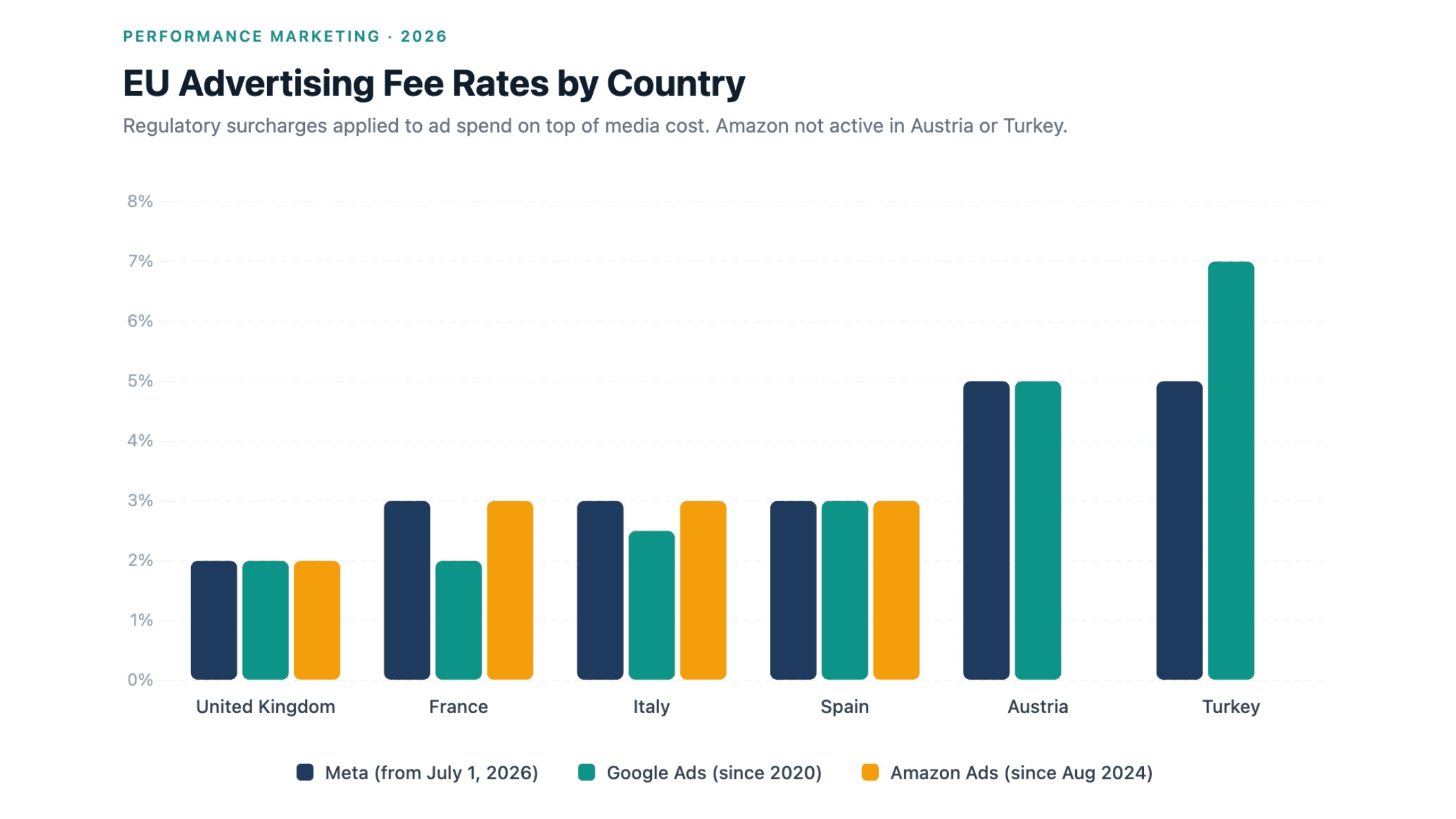
Bar chart showing EU advertising fee rates by country across Meta, Google Ads, and Amazon Advertising in 2026
転嫁の代償
The Cost of Passing the Blame

If you run paid media in Europe, your cost base just changed.

Starting July 1, 2026, Meta adds "location fees" to every campaign delivering impressions in Austria, France, Italy, Spain, Turkey, and the UK. Rates run from 2% to 5% depending on the country. The fee sits on top of your campaign budget, shows up as a separate line on your invoice, and applies based on where your audience is — not where your business is.

This isn't a Meta-only story. Google started doing the same thing in November 2020. Amazon followed in August 2024. The question for lean marketing teams isn't whether to be angry about it. It's whether your budget models, KPI baselines, and reporting are set up to absorb it cleanly — or whether July 1 is going to quietly break your numbers.

Most are not set up. This article walks through what the fees are, why they exist, what they'll actually cost, and the four things you need to fix before the invoices change.

What Are EU Advertising Fees, and Which Platforms Charge Them?

EU advertising fees are regulatory surcharges that ad platforms pass on to advertisers running campaigns in European countries subject to national Digital Services Taxes (DSTs) or significant EU regulatory compliance costs.

The mechanism is consistent across platforms: your campaign spend enters the platform's auction system as normal, the platform buys impressions on your behalf, and then an additional fee calculated as a percentage of spend in the affected country appears on your invoice. The fee is triggered by audience location, not advertiser location.

Current EU advertising fee rates by platform:


Country

Meta (from July 1, 2026)

Google Ads (current)

Amazon Ads (from Aug 2024)

Austria

5%

5%

France

3%

2%

3%

Italy

3%

2.5%

3%

Spain

3%

3%

3%

Turkey

5%

7%

UK

2%

2%

2%

Germany

Bar chart showing EU advertising fee rates by country across Meta, Google Ads, and Amazon Advertising in 2026
Fee rates vary by platform for the same underlying tax liability. France's 3% DST produces a 3% Meta fee and a 2% Google fee — confirming that rate-setting involves commercial judgment, not just cost pass-through.

Two things stand out in this table. First: Google's Turkey rate (7%) is higher than Meta's (5%) for the same underlying DST liability — confirming that fee-setting involves commercial judgment, not just tax pass-through. Second: Germany, Europe's largest advertising market, has no DST and no platform surcharge. For now.

LinkedIn, TikTok, X, Snapchat, and Pinterest have not announced equivalent surcharges as of June 2026. Whether they absorb these costs into base CPMs or haven't structured them as visible line items is unknown. A surcharge announcement from any of these platforms would follow an established pattern, not create a new one.

Why Are These Fees Happening Now?

Three layers of EU regulation have compounded over the past seven years to create a genuine and growing compliance cost for large ad platforms. The fees are how platforms are now passing those costs on.

National Digital Services Taxes

This is the most direct driver. Starting with France in 2019, EU member states began imposing unilateral taxes on the digital revenues of large technology companies. The EU failed to agree on a unified digital tax, so countries moved independently.


Country

DST Rate

In Force Since

France

3%

January 2019

Austria

5%

January 2020

Italy

3%

January 2020

UK

2%

April 2020

Spain

3%

January 2021

Turkey

Various

Various

These taxes apply only to companies with at least €750 million in global revenue and a local revenue threshold, typically €25 million. In practice, they fall almost entirely on US tech platforms. They are real, audited tax liabilities. France's 3% DST is a legal obligation on revenues from French digital advertising, not a discretionary charge.

Meta absorbed this cost for seven years. Google started passing it on within eighteen months of France's DST taking effect. Meta's July 2026 announcement is a delayed convergence with where Google already is.

The Digital Services Act (DSA)

The DSA became broadly applicable on February 17, 2024. Very Large Online Platforms (VLOPs) — which includes Facebook, Instagram, YouTube, TikTok, LinkedIn, Snapchat, X, Amazon, and Pinterest — face obligations including mandatory public ad repositories, restrictions on targeting minors and profiling from sensitive data categories, and annual independent risk audits.

These requirements carry real engineering and legal costs. The first major DSA non-compliance fine was €120 million against X in December 2025, for an inadequate ad repository and restricted researcher access. More enforcement actions are scheduled.

The Digital Markets Act (DMA)

The DMA designated six gatekeepers in September 2023: Alphabet, Amazon, Apple, ByteDance, Meta, and Microsoft. DMA compliance for advertising requires daily performance reporting to advertisers, full transparency on pricing and deductions, and restrictions on combining cross-platform user data without explicit consent.

Meta was fined €200 million under the DMA in April 2025 for its "pay or consent" model. The compliance overhead from DSA plus DMA obligations has been estimated at approximately $200 million per large US platform per year (CCIA, July 2025).

The total picture: Combined DSTs across the five affected countries extract an estimated $1.5 billion annually from US tech platforms (Tax Foundation, 2026). Add DMA and DSA compliance costs and the combined annual EU regulatory burden for these companies runs to approximately $2.2 billion (ITIF, December 2025). The fees are a partial, structured response to a cost that was always real but previously absorbed.

What Will EU Advertising Fees Actually Cost You?

The honest answer varies significantly by scale and geography. Here are four scenarios that span the challenger brand range.

Scenario 1: UK-focused DTC brand

Monthly Meta spend: £5,000, UK-only audience UK fee (2%): £100/month Annual overhead: £1,200

At this scale, the fee is a rounding error. Optimising your creative CTR by 2% will move your results by more than this.

Scenario 2: Mid-market ecommerce brand, Western Europe

Monthly Meta spend: €50,000 across France (30%), Italy (25%), Spain (25%), Germany (20%)

Germany has no fee. The fee applies to 80% of spend.


Country

Monthly Spend

Fee Rate

Monthly Fee

France

€15,000

3%

€450

Italy

€12,500

3%

€375

Spain

€12,500

3%

€375

Germany

€10,000

0%

€0

Total

€50,000


€1,200/month

VAT compounds this. Italy's VAT rate is 22%. You pay that on total billing: media spend plus fee combined. On €12,500 of Italian spend, the fee adds €375, but the VAT applies to the full €12,875. Your actual overhead from the Italian fee lands at approximately €458, not €375.

Annual fee overhead (pre-VAT): €14,400. If you also run Google Ads across the same European markets, you've been paying equivalent fees there for four years already. From July 1, your blended EU advertising overhead from regulatory fees roughly doubles on Meta.

Scenario 3: Large pan-European advertiser

Monthly Meta spend: €500,000 across all EU markets and UK Blended effective fee rate: approximately 2.8% Monthly fee overhead: approximately €14,000 Annual fee overhead: approximately €168,000

This generates no impressions, no clicks, no leads, and no revenue. It's pure compliance pass-through in the billing. For teams with campaign measurement frameworks already set up, this needs to be modelled as a structural cost line before Q3 planning closes.

Scenario 4: B2B SaaS company, LinkedIn-primary

If your primary European paid channel is LinkedIn rather than Meta, you are not currently facing equivalent surcharges. LinkedIn has not announced EU advertising fees as of June 2026. Whether LinkedIn prices DST costs into its base CPMs rather than as a visible line item is unknown. For challenger brands running LinkedIn campaigns on tighter budgets, monitoring for a LinkedIn announcement should be part of your Q3 planning horizon.

The Reporting Problem Nobody Is Talking About

The cost impact is manageable. The reporting impact is where lean teams get caught.

Your KPIs will look worse without touching performance.

Meta's optimisation algorithms don't see the location fee. Your campaigns spend your full stated budget in the auction. But if your ROAS, CPL, or CPA calculations use total invoice spend rather than Ads Manager spend, your reported metrics will degrade from July 1 — not because your campaigns are performing differently, but because your cost denominator increased.

A team running €50,000/month in European Meta spend at a 4.0x ROAS:

  • Pre-July: Total billed cost = €50,000. Reported ROAS = 4.0x.

  • Post-July (same performance, same revenue): Total billed cost = €51,200. Reported ROAS = 3.9x.

The campaign didn't change. The impression volume didn't change. The revenue didn't change. The reported ROAS dropped because the invoice is now larger than Ads Manager shows.

If you report to a CMO, a board, or a client, this needs a methodology note before July — not a retroactive explanation in August. For teams building cross-channel attribution models, any model pulling cost data from billing rather than platform APIs will need a normalisation layer for affected markets.

The broader EU regulatory cost picture is still moving.

Germany — Europe's largest advertising market and currently fee-free — had a proposed national digital advertising tax of 10% under active discussion in June 2025. If enacted, it would create the highest platform surcharge rate in Western Europe and affect a market that currently has no fees at all. A potential EU-wide DST has been proposed, shelved, and revived multiple times. The DSA enforcement calendar will produce additional compliance requirements and fines for platforms through 2027 at minimum.

The direction of travel is one-way. Building EU regulatory ad costs into your standard European media cost model as a permanent structural line — not as a one-off exception — is the correct long-term response. Teams that treat this as a temporary anomaly will face the same planning conversation again when the next country or platform moves.

This is precisely the kind of regulatory signal that should be tracked continuously rather than discovered via platform email. Marketing analytics systems that can ingest platform policy changes and automatically flag their impact on performance benchmarks are what separate teams that stay ahead of this from those that react after the fact.

Is This a Legitimate Cost Pass-Through or a Margin Play?

Worth asking directly, because the answer isn't clean in either direction.

The case for legitimate pass-through:

The DSTs are real, audited tax liabilities. France's 3% DST is a legal obligation. Meta absorbed it for seven years at significant cost. The DSA and DMA compliance burden is independently estimated at hundreds of millions of dollars per platform per year. Google started passing costs on in 2020 — five years earlier than Meta. The fee structure follows a consistent pattern across three separate platforms.

The case for scepticism:

The rates don't always match the underlying tax. France's DST is 3%. Meta charges 3% for France. Google charges 2% for the same market with the same underlying tax. An identical liability produces different rates on different platforms.

No platform discloses its per-market DST liability, so advertisers can't verify that fees collected equal taxes paid. TikTok, LinkedIn, and Snapchat face the same national DSTs and have not introduced visible surcharges. If this were purely mandatory cost recovery, adoption would be uniform.

Meta absorbed these costs for seven years with no apparent material impact on margins. The timing of the change — following Google and Amazon in a clear industry sequence — looks more like competitive normalisation than a sudden tax shock.

The honest conclusion: the fees are partly legitimate pass-throughs and partly pricing decisions. The underlying tax liabilities are real. The rate-setting involves commercial judgment. Both things are true, and they're not going to become untrue. Planning for this as a structural cost is more useful than debating the legitimacy.

What to Fix Before July 1, 2026

1. Pull your geo breakdown now.

Know what percentage of your Meta impressions land in each EU country. This is your fee calculation basis. Pull June data before the July billing cycle starts. Do the same for Google Ads — your blended European fee picture needs both platforms.

2. Recalculate your Q3 budget.

If your approved Q3 Meta budget for Europe is €X, your total billing will be €X plus the blended fee. Either get the budget amended to cover the fee, or plan to reduce media spend by the fee amount to keep total billing flat. If you're already in marketing budget planning mode for the second half of 2026, this is a line item that needs to appear.

3. Decide your KPI denominator and document the decision.

Pick one cost basis for KPI calculations: Ads Manager spend (comparable over time, excludes fees) or total billed (true economic cost). Both are defensible. Using different bases before and after July without flagging the change is how you generate a false performance dip in Q3 reporting. Add a methodology note to any reports that will include July data.

4. Brief finance before the first July invoice.

The line-itemised regulatory fee won't match your Ads Manager figures. Finance will flag it as a billing discrepancy unless you've briefed them in advance. One page, before July 1: which countries, which rates, why the invoice exceeds the campaign budget.

For agencies: Review client contracts before the billing cycle changes. Whether regulatory surcharges pass through to clients or are absorbed depends on how your agreements are written. If it's unclear, clarify it now.

Frequently Asked Questions

Can I opt out of EU advertising fees?

No. The fees apply automatically to any campaign delivering impressions in the affected countries. There is no opt-out. If you want to avoid the fees entirely, you would need to exclude those countries from your targeting — which removes audiences rather than removes costs. For most advertisers, paying the fee and retaining the market access is the rational choice.

Does the fee apply if my business is based outside the EU?

Yes. The fee is triggered by where your ads are delivered, not where your business or billing account is located. A US-headquartered brand targeting French users on Meta pays the 3% France fee. The same applies to Google Ads and Amazon Ads.

What's the difference between EU advertising fees and VAT on advertising?

VAT on advertising (where it applies) is a consumption tax applied to the total value of the transaction, including the regulatory fee. The regulatory fee is a separate line item representing the platform's DST liability pass-through. They stack: in a country with both VAT and a DST fee, you pay VAT on the combined total of media spend plus regulatory fee. Whether regulatory fees qualify as reclaimable input VAT depends on your jurisdiction and business structure — confirm with a tax advisor before assuming reclaimability.

Will other platforms introduce similar fees?

LinkedIn, TikTok, X, Snapchat, and Pinterest have not announced EU advertising fees as of June 2026. All face the same national DSTs and EU compliance obligations as Meta, Google, and Amazon. A surcharge announcement from any of these platforms would not be a surprise — it would follow an established pattern. Monitor platform communications, particularly from LinkedIn, which is the next most likely candidate given its B2B advertiser base and growing EU market presence.

How should I handle EU advertising fees in my attribution model?

If your marketing attribution model uses cost data pulled directly from billing rather than from the Ads Manager API, you will need to normalise for the regulatory fee to maintain comparable cost-per-outcome figures across time periods. The simplest approach: track Ads Manager spend and regulatory fees as separate inputs to your attribution model, and report total economic cost as the sum. This maintains pre/post-July comparability without distorting your performance benchmarks.

The Short Version

EU advertising fees are a structural feature of running paid media in Europe, not a temporary surcharge or a billing anomaly. Google has charged them since 2020. Amazon since 2024. Meta from July 1, 2026.

For lean marketing teams, the practical risk isn't the direct cost — most scenarios produce manageable overheads. The risk is operational: invoices that don't match campaign spend, KPIs that degrade without a performance reason, and Q3 forecasts built on pre-July cost assumptions. Fix the models, brief finance, and document your denominator before the first July invoice arrives.

And build the ongoing monitoring. Meta's own announcement notes that "rates may change over time and countries may be added." This is not a one-time event to react to. It's a regulatory cost environment that will keep evolving — and marketing systems that track and absorb these signals automatically will always be better positioned than teams waiting for another email.

DOJO's Demand Intelligence layer tracks regulatory and platform policy changes that affect your advertising costs and performance benchmarks across every channel — automatically. See how it works.


Sources: Meta Business Help Center (March 2026); Tax Foundation, "Digital Services Taxes in Europe, 2026"; CCIA, "DMA Compliance Cost Analysis" (July 2025); ITIF, "Digital Regulatory Burden Estimate" (December 2025); Google Ads Help Center; Amazon Advertising official policy guide; Brussels Signal (March 2026); EU Court of Justice press release (September 2025).

Try DOJO now.

Join over 100+ brands already growing with us.

FAQ

Frequently asked questions

What is DOJO AI?

Who is DOJO built for?

Is DOJO suitable for marketing agencies?

How does DOJO work with existing tools?

What ROI can I expect?

How does DOJO compare to HubSpot, Jasper, or other AI marketing tools?

Does AI marketing software actually improve over time, or does it reset every session?

How does DOJO handle data security and privacy?

FAQ

Frequently asked questions

What is DOJO AI?

Who is DOJO built for?

Is DOJO suitable for marketing agencies?

How does DOJO work with existing tools?

What ROI can I expect?

How does DOJO compare to HubSpot, Jasper, or other AI marketing tools?

Does AI marketing software actually improve over time, or does it reset every session?

How does DOJO handle data security and privacy?

FAQ

Frequently asked questions

What is DOJO AI?

Who is DOJO built for?

Is DOJO suitable for marketing agencies?

How does DOJO work with existing tools?

What ROI can I expect?

How does DOJO compare to HubSpot, Jasper, or other AI marketing tools?

Does AI marketing software actually improve over time, or does it reset every session?

How does DOJO handle data security and privacy?

Try DOJO now.

Join over 100+ brands already growing with us.

Try DOJO now.

Join over 100+ brands already growing with Dojo AI